UNews Weekly Digest - Friday, 30, August 2019 of The United Methodist Church in Nashville, Tennessee, United States
UNews Weekly Digest - Friday, 30, August 2019 of The United Methodist Church in Nashville, Tennessee, United States
Award winners reach out to communities
JONESBORO, Ark. (UM News) — Ministries with a college rodeo team and drug-addicted people earned recognition with The Harry Denman Evangelism Award in 2019. The Revs. Casey Turner and Thacker Haynes reflect on how they achieved their goals to help others. Jim Patterson has the story that concludes a two-part series.
Read story
Successful evangelism includes trusting the call
Second story of a two-part series by Jim Patterson, UMNews

“We talk about the answer, not the problem,” said Turner, co-founder and executive director of Breaking Bonds Ministries Inc. in Jonesboro, Arkansas. It is a faith-based drug and alcohol rehabilitation program.
Turner, who runs Breaking Bonds with his wife and co-founder, Tiffanie Turner, received a Denman Award at the Arkansas Conference May 29-June 1. The award recognizes exceptional ministries of evangelism.
Instead of focusing on drugs and alcohol, Breaking Bonds counselors talk about Jesus, love, grace and trust, Turner said.
“What I have found after many years of doing this, is if you have somebody who’s been beaten their entire life, sometimes all they need is a little bit of love.”
The Rev. John Miles, senior pastor at First United Methodist Church of Jonesboro, said Turner is reaching “mostly blue collar and lower income” people. Turner is associate pastor at the Jonesboro church.
"Our Tuesday night Breaking Bonds service is full of young people who are either trying to stay clean or trying to get clean,” he said. “It is a beautiful thing to see families restored and children coming with their parents to church.”
Turner, 37, has been drug-free for almost nine years.

fter three months of biblical foundation, participants learn life skills in a curriculum developed through a partnership with FranklinCovey, a Salt Lake City-based corporation that helps organizations achieve results that require lasting changes in human behavior.

Turner is hoping to expand Breaking Bonds, and sees it as one way struggling United Methodist churches can find new energy.
A Sunday morning service called Elevation was drawing about 10 people a week when Turner became associate pastor at First United Methodist Church of Jonesboro. He reinvented it as a “mutual place between the already established church and Breaking Bonds.”
Between Elevation and the Tuesday evening Breaking Bonds service, the church now hosts more than 600 people a week. The church also offers other traditional and contemporary services.
“Breaking Bonds is the tip of the spear in the community outreach,” Turner explained.
Currently, 36 men are recovering from drug addiction in Jonesboro and there are 12 women in a sister program in Steamboat Springs, Colorado.
“We’re going to be planting more,” Turner said. “We have a vision of nationwide free alcohol and drug treatment.”

Haynes knows he annoys his district superintendent in Texas with his lack of specificity when he is asked each year to state his goals.
“I put down: ‘We attempt to do anything that God lays in front of us with his help,’” said Haynes, who serves at McLean-Heald United Methodist Church in McLean, Texas.
"Most of the time there are people that say we don’t have the personnel or the money and I say, ‘We’ll just have to trust God for it.’
“And every time there’s always plenty. It’s pretty amazing.”
Who was Harry Denman?

Denman (1893-1976), a Methodist lay leader and evangelist, frustrated family and friends by continually giving away his winter coats to people who needed them more, according to the Foundation for Evangelism.
Denman — who was against materialism and prejudice and tried to live his life modeled on Jesus and the Sermon on the Mount — helped found The Foundation for Evangelism in 1949.
Each year, annual conferences of The United Methodist Church and The Foundation for Evangelism recognize one youth, one clergy and one lay person in each conference for their achievements.
One such opportunity came along nearly a decade ago, when Haynes was contacted by rodeo coach Cody Heck at Clarendon College. The coach was losing some of his scholarship recipients, who were being kicked out of school because of alcohol and possibly drug use.
Figuring that the best way to someone’s heart is through the stomach, Haynes, along with McLean-Heald congregants Randy and Bobbi Stalls, began bringing the rodeo team a home-cooked meal once a week. That requires a 72-mile round trip from McLean to Clarendon every seven days.
“The cooking, just that ministry alone, we average feeding 75 people,” Haynes said. “It turns out to be 2,700 meals that we feed in the course of a school year.”
There is a speaker after each meal, usually someone connected to the rodeo. Bullfighter Frank Newsom has spoken, as has roper Stran Smith and his wife, Jennifer, an ESPN rodeo commentator.
Last year, the rodeo ministry helped the team through a crisis after team member Michael Dalton O’Gorman, 20, was killed at the Clarendon College Livestock and Equine Center in a skid loader accident.
“We went over there that night and helped to console or tried to console the rest of the rodeo team,” Haynes said. “I guess it was a couple of weeks after the kid’s death, we asked if there were any that wanted to accept Christ and be baptized. We had 14 hands go up. Through the years, counting those 14 last spring, we’ve probably baptized 30.”
Haynes and the Stallses were named as 2019 Denman Award winners in the Northwest Texas Conference.
Although Haynes grew up United Methodist, his wife was a member of the Church of Christ. “We couldn’t agree on a church so we just didn’t go,” he said. “We partied a lot … and that went on until I was about 38.”
Haynes said he had “one of those Holy Spirit moments” while taking a walk. He went back to church and began singing in the choir.
While listening to a sermon one Sunday, “I got exceedingly hot, I started crying and I found myself at the prayer rail. After I was flooded with the enormity of my sin, I heard God say, ‘Thacker, you’re forgiven. But I’ve got something for you to do.’”
To his surprise, he was called to be a United Methodist minister, despite thinking of ministers as “short, fat, bald, with soft hands.”
Appointed as a vocational lay speaker at a United Methodist church in Mobeetie, Texas, he began taking speaking engagements at other churches, and would visit homebound people on Wednesday nights.
“I was feeling unqualified for what I was doing,” he said. “I hadn’t had much training.”
Shortly thereafter, the Rev. Jo Carr, Haynes’ district superintendent, contacted him about McLean-Heald United Methodist Church in rural Texas.
Carr told Haynes that McLean-Heald would not get a pastor that year because there weren’t enough to go around. She requested that he completely answer his call and go to work as a full-time pastor as well as pursue studies toward ordination.
“I said, ‘When do you need an answer’ and she said in 30 minutes. So I called my wife, I said yes, and that’s what I’ve been doing for the last 27 years.”
Patterson is a UM News reporter in Nashville, Tennessee. Contact him at 615-742-5470 or newsdesk@umcom.org. To read more United Methodist news, subscribe to the free Daily or Weekly Digests.
Denman (1893-1976), a Methodist lay leader and evangelist, frustrated family and friends by continually giving away his winter coats to people who needed them more, according to the Foundation for Evangelism.
Denman — who was against materialism and prejudice and tried to live his life modeled on Jesus and the Sermon on the Mount — helped found The Foundation for Evangelism in 1949.
Each year, annual conferences of The United Methodist Church and The Foundation for Evangelism recognize one youth, one clergy and one lay person in each conference for their achievements.
Konsor — who had once helped plant a church and had a long career singing in gospel quartets with his wife — met with the Rev. Keith Nelson, then a United Methodist district superintendent in North Dakota. It was agreed that Konsor would meet with city leaders in Watford City to find out the greatest needs of the area, which turned out to be a thrift store and ways to feed people.
“We needed to help these new families coming to town,” he explained. “That was the seed of it.”
A miracle offering was taken by the Northwest District of the Dakotas Conference. The hope was to raise $100,000. The actual take was $270,000.
Real estate prices had skyrocketed, so they worked with what they could get, said the Rev. Kermit Culver, Northwest District superintendent of the Dakotas Conference, in his nomination of the Konsors for the Denman Award.
With a converted camper trailer and three storage units, the community-wide ministry has provided thousands of people with warm clothing, household items, furniture and other assistance, Culver said.
The camper was set up near an existing food pantry “so when people came for food, they could come for clothing,” Konsor said.
“We went on a rampage to get stuff to stock it with, and so it grew from that kind of begin
At one point the ministry was running out of money, so they began charging nominal amounts for the clothing — along the lines of two or three dollars for jeans and shirts. No one complained. If a family can’t afford even that, they usually can get what they need for free.
Comedy Café — an annual fundraiser featuring the performance of a comedian — usually raises $35,000 to $40,000 for the ministry, Konsor said. The annual Christmas celebration to give presents to needy children generates donations as well.
Today, the Bakken Oil Rush Ministry is a self-supporting, self-funded, 501(c)(3) ministry operation set on a 1.3-acre site owned by the ministry. They have expanded into offering furniture.
Jim and Kathy Konsor have retired and a new director, the Rev. Dwayne Keener, took over on July 1. He recently retired as an Air Force chaplain at Minot Air Force Base in Minot, North Dakota, and holds credentials with the Wesleyan Church.
“I’m 67,” Konsor said. “I started this when I was 60. I drug my wife into it and it was just a do-whatever-it-takes life. It was all-consuming to make something from nothing, but the real key is God gave us great grace to be able to put in the kinds of hours do the things we did.”
The Denman Awards from the Dakotas Conference were not expected, he said. Jim Konsor won in the clergy category, while Kathy Konsor won in the laity category.
“It was a surprise,” Jim Konsor said. “You’re trying to help people and honor God, and to have others in the conference recognize it is very humbling, actually.”

The resource center serves about 2,600 people a month with free clothing, food, personal hygiene and household items, internet access and referrals to other community resources. It is a ministry of St. Mark’s United Methodist Church in the conference’s Northwest Plains District.
Roark said she felt “blessed and grateful” to be chosen for the Denman Award. “I could not have (won the award) without the great workers (at the resource center) and God by my side,” she said. “So I felt like there could have been so many other names added to that (award).”
In an article on the West Ohio Conference website, the Rev. Ted Bible of St. Mark’s said that Roark has created an atmosphere at the resource center where “each person is greeted with a warm smile, encouragement, honesty, an eagerness to help, and if God prompts, a prayer and hug.”
Her experiences allow her to empathize with her clients, Roark said.
“Most of the people I work with don’t trust anybody,” she said. “A lot of people have told them they’re going to help them and it never came to fruition.”
People who are hurting don’t usually volunteer the reasons why they need help at first, Roark said.
“So we try to go above and beyond just being a food pantry. … You just have to build a relationship with them. And eventually, it comes out. They’ll tell you.”
Those relationships are helped by Roark’s openness about the pain in her past.
But when she was 27, a new baby daughter died of meningitis at 7 days old. “I did not know how to deal with that,” she recalled. “I grew up hearing that God was a punishing God. I didn’t know what God was punishing me for.”
Lol
Roark turned to drugs, lost her home to the bank and her husband to prison in short order.
She accepted help from the first man who pledged to get her and her children off the streets. He turned out to be an addict and a batterer, and she ended up homeless again.
“There was a (United Methodist pastor) who reached out to me only because she knew there were issues because she did after-school programming at the school my children went to,” Roark said.
In November of that year (2012), Roark had a hysterectomy that went bad and necessitated another surgery to clear up an infection. She had trouble sleeping during the recovery. She felt like God was trying to tell her something.
“I don’t know if it’s the first time that I’ve actually slowed down enough to listen to Him or if it was His way of slowing me down to listen to Him, but He kept telling me that I had to give back what was given to me,” Roark said.
She took her idea of “a food pantry that’s so much more than just a food pantry” to her pastor, the Rev. Barbara Dafler.
“That’s where our resource center started,” Roark said. “In our first month, we had 11 clients.”
Knowing the feeling of standing in a food line with her children, Roark is dedicated “to not allowing anyone to feel like that."
“We want everyone to feel welcome and not to feel bad for their situation,” Roark said. “We’re really supposed to be there just helping each other.”
Coming Thursday, Aug. 29: Successful evangelism includes trusting the call
Patterson is a UM News reporter in Nashville, Tennessee. Contact him at 615-742-5470 or newsdesk@umcom.org. To read more United Methodist news, subscribe to the free Daily or Weekly Digests.
Sierra Leone Conference settles land dispute
FREETOWN, Sierra Leone (UM News) — The Sierra Leone Conference has agreed to give 60 acres of its Pa Loko property in rural eastern Freetown to the neighboring Masantigie community to resolve a years-long property battle that had turned violent. Phileas Jusu reports.
Read story
Sierra Leone Conference settles land dispute by Phileas Jusu, FREETOWN, Sierra Leone (UM News)

The conference and community have been at odds over the property for seven years, and the community has lost at least two lawsuits concerning rights to the land.
The local United Methodist church at Pa Loko and caretaker families who reside on the land have been the victims of repeated incidents, including burglary and attempted arson. In a recent confrontation, at least five members of Mango Brown United Methodist Church were wounded, three of them seriously, after a dawn raid on their homes.
After the attack, Bishop John K. Yambasu met with Sierra Leone President Julius Maada Bio to ask for help, noting that previous efforts by the land ministry were not enough to stop the violence against the church and its members.
Bio constituted an expanded team to resolve the matter while appealing to the bishop to exercise restraint.
After mediation, an agreement was reached between the two sides, granting the Sierra Leone Conference 256 acres of land and the Masantigie community 60 acres. An additional 127 acres of the property not under dispute will remain with The United Methodist Church, bringing its total acreage to 383.
Survey work to demarcate the 60 acres was completed Aug. 21.
Following the decision, Denis Sandy, Sierra Leone Minister of Lands, Housing and Environment, addressed a community meeting featuring government officials, church leaders and members of the Masantigie community.
“I’m happy to be here this afternoon for the fourth time,” said Sandy, recalling how long the matter has taken to resolve.

Emery Lohandjola, nurse manager of Majengo Health Center — a United Methodist hospital in Goma — said he fears the worst for his area. More than 37 cases of cholera were observed in July and the number has continued to increase in August, he said. From Aug. 1-20, there have been at least 45 cases of cholera reported at the health center.
“My health area is very much exposed by this cholera outbreak because there is a lack of drinking water,” Lohandjola said.
Cholera is an infectious disease usually spread through contaminated water. It causes severe diarrhea and dehydration and can be deadly if left untreated.
In May, Congo’s Ministry of Health, with support from the World Health Organization, began a vaccination campaign aimed at immunizing more than 800,000 people against cholera in North Kivu, according to ReliefWeb.
Despite those efforts, at least four people have died from cholera since July 5 in Goma and the neighboring Nyiragongo territory, according to health authorities in the region.
Action and Intervention for Development and Social Coaching, a local organization that helps health facilities fight cholera, set up a health checkpoint outside of Majengo Health Center in June to deal with cholera cases.
The Rev. Omole Owandjakoyi expressed concern about the cholera epidemic in his ecclesiastical district of Goma, which has more than 8,000 members.
Dr. Damas Lushima, general coordinator of health for the church in Eastern Congo, blamed overcrowding and an often unhealthy water supply for the outbreak in Goma.
“Cholera outbreaks can occur sporadically in any part of the world where water supplies, sanitation, food safety and hygiene practices are poor. Overcrowded communities that live in poor sanitation and do not have a safe drinking water supply are those most commonly affected,” he said.
“As a church, we will first have to start educating our communities about the rules of hygiene and make pleadings with our health partners to find water supplies in this area ...,” he said.
The Rev. Kinane Chrisostome of Amani United Methodist Church in Goma educated his members during Sunday service on Aug. 25 about how to wash hands properly to prevent “dirty hands diseases” like cholera.
“I will take every Sunday, even five minutes, to sensitize the faithful on washing hands to fight against diseases of dirty hands,” he said.
Chrisostome received training from Megan Klingler with the United Methodist Board of Global Ministries’ Global Health unit, who arrived in Congo last week. A nurse from Montana, Klingler is visiting six cities during her three-week trip to conduct training sessions to help stop the spread of Ebola by healthcare workers, providers and family caregivers.


 Rev. Cady proclaimed, “The success of this event is not setting a record. The success is standing in a divided world and spreading the love so thank you, thank you, thank you for coming out.”
World Record or not, each person in line gave the person next to them genuine embraces. Friends were made and positivity filled the air.
Research also shows that today people are hug-deprived, even by loved ones. And because of this, feelings of loneliness are often reported as well as more severe consequences like increased aggression and depression.
While a World Record was not set at Asbury First UMC, powerful hugs were exchanged, people were uplifted, and division was conquered. The Upper New York Conference’s mission of “Being God’s love to our neighbors in all places” was beautifully demonstrated.
Michigan Conference
Chaplains help support police work
LANSING, Mich. — Police officers have to see and do things that other people don't. Police chaplains like the Rev. Andrew Jackson say they help build bridges with the community, do individual counseling, officiate at funerals and more. Diane Brown has the story.
Read story
THEY TAKE CHURCH OUTSIDE THE BUILDING
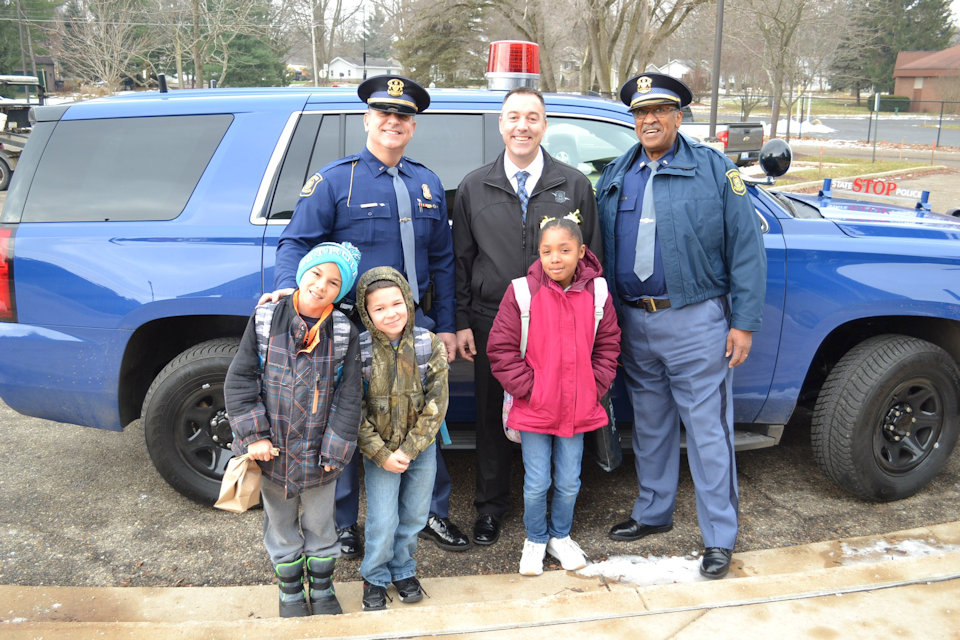
The Rev. Andrew Jackson should know. He’s been a chaplain with the Michigan State Police (MSP) for 17 years.
“Being a chaplain is where you can serve beyond the four walls and make a difference in people’s lives,” Jackson said. “The officers will appreciate you in a way you’d never expect or receive anywhere else.”
Chaplain duties vary by agency or department. Some agencies look to their chaplain to help build bridges between the officers and the community. Others, like MSP, identify chaplains to provide pastoral services to members of the department and their families, participate in department ceremonies, counsel officers, visit sick or injured members, and officiate at department funerals.
“If you want to be a servant called by God and be an example for people, this is a good place for you,” Jackson said. “The (officers) have a need for someone to care for them. Even though they walk around in a uniform and with guns, they see some of the most unbelievable things that happen in our world. They appreciate you being there for them, sometimes when their lives fall apart.”
A retired elder from the former West Michigan Conference, Jackson began his chaplain ministry when a fellow UMC pastor, the Rev. Bill Sanders, invited him to serve. Sanders, also a retired elder, recently was honored by the MSP as Chaplain of the Year for 2018.
“We are chaplains for the troopers and their families, not for the community,” Jackson explained. “I do whatever I can do to assist the officers. I do ride-alongs and death notifications. But I’m there for the officers. That’s the most important thing. I’ve never ridden with anyone who didn’t have a faith-based question of me. I want to be a chaplain not a trooper. I’m not a wanna-be (cop). I don’t have to be anything other than a chaplain. I’m just there to assist.”
“I’ve never ridden with anyone who didn’t have a faith-based question of me. I want to be a chaplain not a trooper. I’m not a wanna-be (cop).” ~ Rev. Andrew Jackson
The Rev. June Marshall-Smith, senior pastor at Novi UMC, has served as a chaplain for the Novi police and fire departments for 12 years.
“Humbling grace would best describe the work I do,” she said. “A call from the dispatch means I will change into my uniform and head to a home or business and forgo what I was doing.”
Chaplains receive additional training with the police agencies and often are provided with uniforms and personal protective equipment. Jackson and Marshall-Smith said their hours vary, but average two to four calls or visits a month.
“One day I was asked to meet our officers at Providence Park Hospital,” Marshall-Smith recalled. “After asking, I was assured that it was not one of our officers. I was informed that it was a baby. This is highly unusual since the hospital has its own chaplain ministry. They explained that they needed me for the family and our officers.
“God was present with me when I took the parents to their two-week-old baby. I prayed for God’s grace in those moments as I held that beautiful still child of God in my arms and baptized her in the name of the Father, and the Son and the Holy Spirit. The water of baptism still on my hand as the blood from the tube in her head trickled to join the water of baptism. That moment we felt God’s presence as mother, father, officer, nurse and chaplain formed the community of believers to dedicate her to God.”
Some of the most difficult times for police chaplains are following deaths of officers. Jackson experienced that in his first year in the role.
“We had a trooper killed in line of duty,” Jackson recalled. “I was instrumental in assisting with his funeral, but it was very difficult. It was my first time as chaplain. I learned a lot. But I carried with me my experiences, including 30-plus years in public education and as a pastor.”
“We see some pretty horrible things. The chaplain corps helps us cope with that.” ~ First Lieutenant Chris McIntire
Marshall-Smith agrees that officer deaths can be incredibly difficult occasions for a police chaplain, but also crucially important for the well-being of the agency.
“Tim, a well-loved officer who could have retired, was living a life of huge responsibility. He died by suicide after a full day’s work on the job,” Marshall-Smith said. “The entire department was devastated, and we quickly set up a schedule for our officers to spend time with the chaplains. After clearing a busy calendar, I spent two weeks, alternating shifts to talk with and pray with our officers. I did the hardest, gut-wrenching and fulfilling ministry with those officers in the weeks after (his) death. It was in those moments that I truly served those officers like I expected to serve.
“Over the years, I have gotten to know all the officers by riding in their cars, baptized their children, volunteered at police golf outings and even buried parents of a records clerk. I serve them without judgment as I listen to their stories of heartbreak, watching families neglect their children, and as I hear of heartbreak in their own lives,” Marshall-Smith adds.
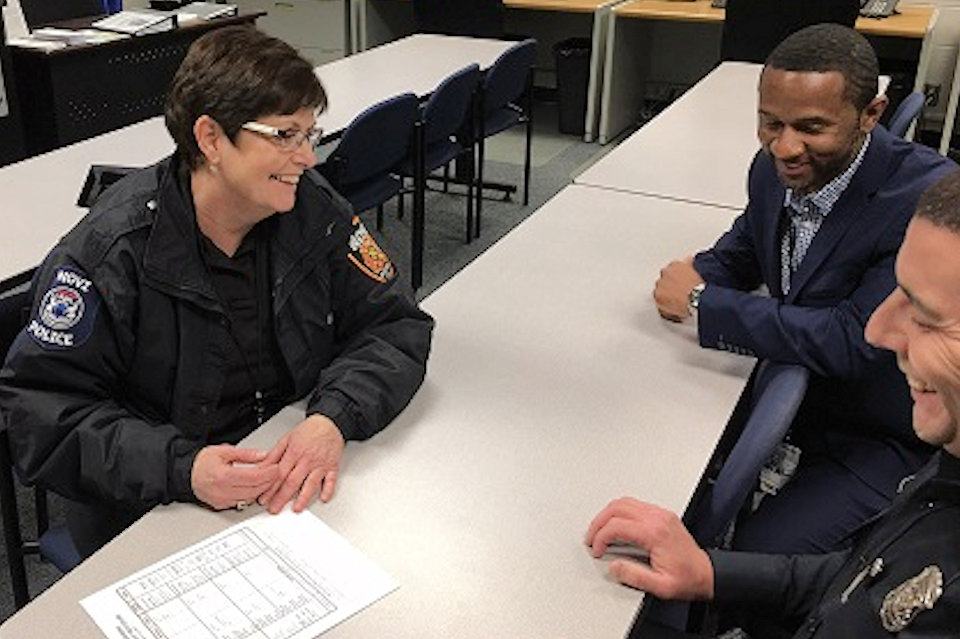
“One of most difficult things in law enforcement is to deliver a death notification,” said First Lieutenant Chris McIntire, commander at the MSP Rockford post. “Our chaplain corps come out no matter what time of day or night to give the horrible news. With their training, they help deliver that news in a compassionate way. No matter what religion.”
But occasionally the presence of a police chaplain initially can be misunderstood. Marshall-Smith recalled making a “well-being” check with her officer for an elderly woman who hadn’t responded to her son’s daily phone call.
“As I held her in my arms and she cried tears of relief, I realized the magnitude of the work we do for the departments we serve.” ~ Rev. June Marshall-Smith
“She stood in the doorway of her condo shaking like a leaf,” Marshall-Smith said. “It was obvious to me that she was shaken to the core to have the police standing at her door. I asked her a second time if she was okay because things did not seem right the way she was quaking. She looked me square in the eye and said, ‘Seeing you on my doorstep has been the biggest fear of my life!’ I told her I did not understand, thinking the cop standing next to me invoked a lot more fear than a middle-aged, chubby woman.
“She explained that she was the ex-wife of a Detroit police officer and her greatest fear was to see a chaplain who always delivered the bad news of their loved one. As I held her in my arms and she cried tears of relief, I realized the magnitude of the work we do for the departments we serve.”
Mental well-being is a challenge in law enforcement. McIntire and Jackson explained that a vital role of the chaplain corps is to listen to officers and provide counseling, when asked.
“We see some pretty horrible things,” McIntire said. “The chaplain corps helps us cope with that. The law enforcement rate of suicide (and divorce) is incredibly high, often because we don’t know how to deal with the horrors.
“The goal of the chaplains is to be there, but not too much. Jackson took it upon himself to ride with officers after they had faced difficult situations. He never proactively inserted himself into a situation, but he was there to help.”
Jackson doesn’t limit his relationship-building to just on-duty time. He’s conducted five weddings of officers or family members.
“I also spend fun time away from the post. We play cards, have dinner, meet with them in other places. I see them out of their uniform – and that makes a difference too. Officers are people too. We need to see them that way.”
Getting involved in chaplaincy may require a waiting period for an opening and not all police agencies have police chaplain assignments. But Jackson encourages any clergy person to ask an MSP post commander or local police agency chief about the opportunity.
“We don’t get paid,” Jackson said. “But if you want to make a difference in someone’s life. There are people who could use your skills, your knowledge, your nurturing.
“Church has to get beyond the four walls. Be a haven for a person, be a shoulder and a leader even if they never walk through the door,” he concluded.
California-Nevada Conference
Church rises from ashes after 2016 wildfire
LOWER LAKE, Calif. — Community United Methodist Church is rising from the ashes of the 2016 Clayton Wildfire. The church broke ground on a new building Aug. 11. Cate Monaghan has the story.
Read story
'Out of the Ashes': Community UMC in Lower Lake Breaks Ground by Cate Monaghan
Interim Director of Communications

“Out of the ashes, we will rise” proclaimed a banner as Great Northern District Superintendent Blake Busick, Pastor John Pavoni, and Lake County Supervisor MokeSimon led the groundbreaking ceremony.
The main church building, the parsonage, and the classroom building were lost in the fire but, “We haven’t missed a service,” the pastor says proudly. On the first Sunday after the fire, since no one was allowed into the area, the congregation met at Community UMC in Clearlake – but each week thereafter, services have been held in the Lower Lake church’s social hall.
(While the social hall remained intact, it was later discovered that its roof tiles had been so heat-damaged that they crumbled when walked on, requiring the roof to be replaced.)
A food pantry was relocated to a container that the church refurbished – adding insulation, electrical, exhaust fans, and refrigeration. From it, volunteers distribute food to those who need it twice a week, only missing one week of service because of the fire: “We have been stepping right along; we haven’t let it tear us apart,” Pavoni says.

 Mabuhay! I am Camille Bianca S. Manangan, but most people call me “CamCam” and I am from Manila, Philippines.
My country is known for its rich biodiversity. The popular tourist destinations are the beaches, heritage towns, monuments, mountains, rainforests, islands and diving spots. However, we are also known for our unemployment rate, poverty, poor infrastructure, heavy dependence on remittances, corruption, political dynasties, traffic, drugs and extra-judicial killings.
There are many marginalized sectors in the Philippines, but over the years, the Philippine government has failed to address the injustices its people face.
By failing to provide the basic human rights of: life, liberty, security, quality education, equality, freedom from discrimination, a fair trial and privacy, the Philippine government has failed to make the lives of its people as comfortable as possible.
As a young leader in The United Methodist Church and an aspiring lawyer, I have always wanted to have an experience regarding issues of human rights. I was blessed with the opportunity I received to serve as a fellow with the General Board of Church and Society. I spent 10 weeks in Washington D.C. and worked alongside Rev. Jeania Ree V. Moore, the director of civil and human rights for Church and Society.
One memorable experience as a fellow was when I attended a prayer vigil for murdered indigenous women.
The vigil made me realize that the Lumad people of the Philippines, who are fighting for their rights to education and ancestral lands, are similar to the indigenous women in the United States, who are being murdered and kidnapped without protection or due process.
I did research on extra-judicial killings in my country to see how the faith community is responding to this injustice.
This fellowship provided me with great insight and connections. As I conducted my research, I read articles and spoke with many different people from various annual conferences and jurisdictions within The United Methodist Church working with Filipinos in the Philippines to speak out and work toward a more just society. The church is doing something by talking to people and naming this injustice. The church is providing care to people who have lost a loved one because of the killings.
The fellowship program at Church and Society made me more critical. The staff members and their work taught me about solidarity and speaking out. I am now actively seeking change, and more resilient and brave to speak up. I am now thinking about making better youth programs within our annual conference, just like the Ecumenical Church and Society Affairs Camp we hosted last March. During this camp, young people within my conference gathered and visited hansenites, also known as leprosy patients, at a hospital to learn more about their stories.
My prayers are entwined with the prayers of other people. I pray for a better church, a church that refers to “us”, the people who are the temple of God’s love and hope.
As an alumni of the Church and Society Fellows program, I can say my life should impact all people, as I am called to be in solidarity. I am with my fellow Filipino people, who are all striving to survive the injustices of our country.
The Church and Society Fellows program allows individuals to research and work alongside the staff of Church and Society to address a specific justice issue. Fellows learn how the staff of Church and Society works to address justice issues, intersectionally and collaboratively, with faith-based partners at the national and grassroots levels. I encourage you to discover how Church and Society resources and equips the church to seek justice and pursue peace in society.
This full-time opportunity offered by Church and Society is designed for spiritual, professional development and discernment. Fellows live in intentional community and are part of a cohort for reflection and experiential learning. This year’s program dates are September 20 through November 30.
Church and Society Fellows will receive a stipend upon completion of the program’s requirements. To apply, please visit here.


“For the body does not consist of one member but of many.” I Corinthians 12:14
The week of August 11-17, 2019, was probably the most diverse week ever recorded at the United Methodist Red Bird Mission Work Camp, in Beverly, Kentucky. Onto that campus came a group of about 75 Christians from many places, representing many forms of diversity.
 This included:
Ethnicity (African American, African, Korean, Latino, European-American);
Location (Delaware, Washington DC, South Dakota, Minnesota, Pennsylvania, New Jersey, New York, Arizona, Texas);
Age (between age 8 to 80);
Denomination (United Methodists, ELCA Lutherans, Unity);
Denominational role (pastors, deacons, district superintendents, a bishop, certified lay ministers, lay people);
Ability (Deaf, Hard of Hearing, mobility-challenged, able-bodied); and
Gender and sexual orientation.
The groups were sent out each day to work on various projects: building wheelchair access ramps, repairing floors, upgrading bedrooms, and arranging donated clothing for distribution.
We included carpenters, electricians, painters, sign language interpreters, photographers, cleaners, dish washers and people who prayed and led worship. We also experienced the diversity of interacting with the homeowners where we worked and learned of their lives and culture in Appalachia.
 We experienced their warm hospitality and the hospitality of the Red Bird Mission staff, conference leaders, work crew leaders and local neighbors we met on our field trips out in the community.
What made this mission trip especially unique was the large number of culturally Deaf* members on the team—20 of them! They were part of “Deaf ELM” (ELM stands for Episcopal, Lutheran and Methodist).
This ecumenical organization of Deaf folks and their advocates work together on various common goals of inclusion and empowerment. History was made on this trip when for the first time members engaged in “hands-on mission work.”

United Methodist News Service <newsdesk@umcom.org>
UM News Weekly Digest
Top viewed stories from Aug 23-Aug. 29. See all United Methodist News Service stories atwww.umnews.org.
NEWS AND FEATURES Award winners reach out to communities
JONESBORO, Ark. (UM News) — Ministries with a college rodeo team and drug-addicted people earned recognition with The Harry Denman Evangelism Award in 2019. The Revs. Casey Turner and Thacker Haynes reflect on how they achieved their goals to help others. Jim Patterson has the story that concludes a two-part series.
Read story
Successful evangelism includes trusting the call
Second story of a two-part series by Jim Patterson, UMNews
The Rev. Casey Turner baptizes a man trying to overcome addiction at the Breaking Bonds Ministries campus in Jonesboro, Arkansas. Photo courtesy of Breaking Bonds Ministries.
An addict turned drug counselor, the Rev. Casey Turner won’t name his old choice of poison. He says there are too many from which to choose. Plus, he prefers to look forward.“We talk about the answer, not the problem,” said Turner, co-founder and executive director of Breaking Bonds Ministries Inc. in Jonesboro, Arkansas. It is a faith-based drug and alcohol rehabilitation program.
Turner, who runs Breaking Bonds with his wife and co-founder, Tiffanie Turner, received a Denman Award at the Arkansas Conference May 29-June 1. The award recognizes exceptional ministries of evangelism.
Instead of focusing on drugs and alcohol, Breaking Bonds counselors talk about Jesus, love, grace and trust, Turner said.
“What I have found after many years of doing this, is if you have somebody who’s been beaten their entire life, sometimes all they need is a little bit of love.”
The Rev. John Miles, senior pastor at First United Methodist Church of Jonesboro, said Turner is reaching “mostly blue collar and lower income” people. Turner is associate pastor at the Jonesboro church.
"Our Tuesday night Breaking Bonds service is full of young people who are either trying to stay clean or trying to get clean,” he said. “It is a beautiful thing to see families restored and children coming with their parents to church.”
Turner, 37, has been drug-free for almost nine years.
Clients at Breaking Bonds Ministries battling drug and alcohol addictions embrace as part of the therapy to rebuild their lives. Breaking Bonds has a campus in Jonesboro, Arkansas, for men and another in Steamboat Springs, Colorado, for women. Photo courtesy of Breaking Bonds Ministries.
"I grew up in a drugs atmosphere and didn’t really know any different until I was 27 years old and I encountered Jesus Christ in His grace and quit through a program similar to (Breaking Bonds),” Turner said.
The Breaking Bonds program is intertwined with his Jonesboro church and also has relationships with corporations that provide men in the program with job training.fter three months of biblical foundation, participants learn life skills in a curriculum developed through a partnership with FranklinCovey, a Salt Lake City-based corporation that helps organizations achieve results that require lasting changes in human behavior.
Read more
Stories about Denman Evangelism Award winners the Rev. James “Jim” Konsor, Kathy Konsor and Jessie Roark are available in the first story of this series
The final phase, transition, is the last month of the Breaking Bonds program. It focuses on tying up legal affairs, getting driver’s licenses reinstated and finding work and housing.Turner is hoping to expand Breaking Bonds, and sees it as one way struggling United Methodist churches can find new energy.
A Sunday morning service called Elevation was drawing about 10 people a week when Turner became associate pastor at First United Methodist Church of Jonesboro. He reinvented it as a “mutual place between the already established church and Breaking Bonds.”
Between Elevation and the Tuesday evening Breaking Bonds service, the church now hosts more than 600 people a week. The church also offers other traditional and contemporary services.
“Breaking Bonds is the tip of the spear in the community outreach,” Turner explained.
Currently, 36 men are recovering from drug addiction in Jonesboro and there are 12 women in a sister program in Steamboat Springs, Colorado.
“We’re going to be planting more,” Turner said. “We have a vision of nationwide free alcohol and drug treatment.”
The Clarendon College Ranch Horse Team represents the oldest institution of higher education in the Texas Panhandle at competitions throughout Texas in ranch and stock horse events. The team also promotes a deep ranching tradition in the state. Photo courtesy of Clarendon College.
The Rev. Thacker Haynes won his Denman Award by responding to a call for help.Haynes knows he annoys his district superintendent in Texas with his lack of specificity when he is asked each year to state his goals.
“I put down: ‘We attempt to do anything that God lays in front of us with his help,’” said Haynes, who serves at McLean-Heald United Methodist Church in McLean, Texas.
"Most of the time there are people that say we don’t have the personnel or the money and I say, ‘We’ll just have to trust God for it.’
“And every time there’s always plenty. It’s pretty amazing.”
Who was Harry Denman?
Photo: The Foundation for Evangelism
Harry Denman, namesake of the Harry Denman Evangelism Award, supposedly owned but one rumpled suit. He usually had just one pair of shoes and didn’t wear a watch because it’s easy to start a conversation with, “Do you have the time?”Denman (1893-1976), a Methodist lay leader and evangelist, frustrated family and friends by continually giving away his winter coats to people who needed them more, according to the Foundation for Evangelism.
Denman — who was against materialism and prejudice and tried to live his life modeled on Jesus and the Sermon on the Mount — helped found The Foundation for Evangelism in 1949.
Each year, annual conferences of The United Methodist Church and The Foundation for Evangelism recognize one youth, one clergy and one lay person in each conference for their achievements.
One such opportunity came along nearly a decade ago, when Haynes was contacted by rodeo coach Cody Heck at Clarendon College. The coach was losing some of his scholarship recipients, who were being kicked out of school because of alcohol and possibly drug use.
Figuring that the best way to someone’s heart is through the stomach, Haynes, along with McLean-Heald congregants Randy and Bobbi Stalls, began bringing the rodeo team a home-cooked meal once a week. That requires a 72-mile round trip from McLean to Clarendon every seven days.
“The cooking, just that ministry alone, we average feeding 75 people,” Haynes said. “It turns out to be 2,700 meals that we feed in the course of a school year.”
There is a speaker after each meal, usually someone connected to the rodeo. Bullfighter Frank Newsom has spoken, as has roper Stran Smith and his wife, Jennifer, an ESPN rodeo commentator.
Last year, the rodeo ministry helped the team through a crisis after team member Michael Dalton O’Gorman, 20, was killed at the Clarendon College Livestock and Equine Center in a skid loader accident.
“We went over there that night and helped to console or tried to console the rest of the rodeo team,” Haynes said. “I guess it was a couple of weeks after the kid’s death, we asked if there were any that wanted to accept Christ and be baptized. We had 14 hands go up. Through the years, counting those 14 last spring, we’ve probably baptized 30.”
Haynes and the Stallses were named as 2019 Denman Award winners in the Northwest Texas Conference.
Although Haynes grew up United Methodist, his wife was a member of the Church of Christ. “We couldn’t agree on a church so we just didn’t go,” he said. “We partied a lot … and that went on until I was about 38.”
Haynes said he had “one of those Holy Spirit moments” while taking a walk. He went back to church and began singing in the choir.
While listening to a sermon one Sunday, “I got exceedingly hot, I started crying and I found myself at the prayer rail. After I was flooded with the enormity of my sin, I heard God say, ‘Thacker, you’re forgiven. But I’ve got something for you to do.’”
To his surprise, he was called to be a United Methodist minister, despite thinking of ministers as “short, fat, bald, with soft hands.”
Appointed as a vocational lay speaker at a United Methodist church in Mobeetie, Texas, he began taking speaking engagements at other churches, and would visit homebound people on Wednesday nights.
“I was feeling unqualified for what I was doing,” he said. “I hadn’t had much training.”
Shortly thereafter, the Rev. Jo Carr, Haynes’ district superintendent, contacted him about McLean-Heald United Methodist Church in rural Texas.
Carr told Haynes that McLean-Heald would not get a pastor that year because there weren’t enough to go around. She requested that he completely answer his call and go to work as a full-time pastor as well as pursue studies toward ordination.
“I said, ‘When do you need an answer’ and she said in 30 minutes. So I called my wife, I said yes, and that’s what I’ve been doing for the last 27 years.”
Patterson is a UM News reporter in Nashville, Tennessee. Contact him at 615-742-5470 or newsdesk@umcom.org. To read more United Methodist news, subscribe to the free Daily or Weekly Digests.
Read Part 1: Denman Award winners stand out as evangelists
Denman Award winners stand out as evangelists
First of a two-part series by Jim Patterson, UM News

Reflecting after his retirement last June, Konsor is amazed and thankful for all that’s been accomplished.
Not as a truck driver, though.
The Konsors leave behind a legacy of helping the multitudes that arrived to work in the Bakken Oil Fields only to find that the local economy fell short when it came to basic services.
“It was kind of like gold-rush days, only with pickup trucks and semi-trucks,” said Jim Konsor. “It was noisy and loud and chaotic and overrun.”
The Konsors are among the notable winners of the Harry Denman Evangelism Award in 2019.

“It was like, ‘Come to us,’ you know? That bothered me,” he said.
“I’m an out-of-the-box thinker anyway. When someone says, ‘We’ve always done it this way,’ I’m just instantly irritated. It’s just the way I roll.”
Who was Harry Denman?
Denman Award winners stand out as evangelists
First of a two-part series by Jim Patterson, UM News
The Rev. James Konsor reads to children during a Christmas season event at the Bakken Oil Rush Ministry in Watford City, N.D. The ministry provides clothing, household items, furniture and more to needy families at a nominal price. Photo courtesy the Bakken Oil Rush Ministry.
When the Rev. James “Jim” Konsor and his wife, Kathy, arrived in Watford City, North Dakota, about seven years ago, it was to take advantage of the oil boom there with a well-paying job as a truck driver.Reflecting after his retirement last June, Konsor is amazed and thankful for all that’s been accomplished.
Not as a truck driver, though.
The Konsors leave behind a legacy of helping the multitudes that arrived to work in the Bakken Oil Fields only to find that the local economy fell short when it came to basic services.
“It was kind of like gold-rush days, only with pickup trucks and semi-trucks,” said Jim Konsor. “It was noisy and loud and chaotic and overrun.”
The Konsors are among the notable winners of the Harry Denman Evangelism Award in 2019.
Kathy and the Rev. Jim Konsor at the Bakken Oil Ministry thrift shop in Watford City, 5.D. The couple retired from the ministry July 1. Both were named as winners of the Harry Denman Evangelism Award in 2019. Photo courtesy the Bakken Oil Rush Ministry.
Walking for exercise through Watford City after work, Konsor noticed churches with “Everybody is welcome here,” signs, but there didn’t seem to be anything happening.“It was like, ‘Come to us,’ you know? That bothered me,” he said.
“I’m an out-of-the-box thinker anyway. When someone says, ‘We’ve always done it this way,’ I’m just instantly irritated. It’s just the way I roll.”
Who was Harry Denman?
Photo: The Foundation for Evangelism
Harry Denman, namesake of the Harry Denman Evangelism Award, supposedly owned but one rumpled suit. He usually had just one pair of shoes and didn’t wear a watch because it’s easy to start a conversation with, “Do you have the time?”Denman (1893-1976), a Methodist lay leader and evangelist, frustrated family and friends by continually giving away his winter coats to people who needed them more, according to the Foundation for Evangelism.
Denman — who was against materialism and prejudice and tried to live his life modeled on Jesus and the Sermon on the Mount — helped found The Foundation for Evangelism in 1949.
Each year, annual conferences of The United Methodist Church and The Foundation for Evangelism recognize one youth, one clergy and one lay person in each conference for their achievements.
Konsor — who had once helped plant a church and had a long career singing in gospel quartets with his wife — met with the Rev. Keith Nelson, then a United Methodist district superintendent in North Dakota. It was agreed that Konsor would meet with city leaders in Watford City to find out the greatest needs of the area, which turned out to be a thrift store and ways to feed people.
“We needed to help these new families coming to town,” he explained. “That was the seed of it.”
A miracle offering was taken by the Northwest District of the Dakotas Conference. The hope was to raise $100,000. The actual take was $270,000.
Real estate prices had skyrocketed, so they worked with what they could get, said the Rev. Kermit Culver, Northwest District superintendent of the Dakotas Conference, in his nomination of the Konsors for the Denman Award.
With a converted camper trailer and three storage units, the community-wide ministry has provided thousands of people with warm clothing, household items, furniture and other assistance, Culver said.
The camper was set up near an existing food pantry “so when people came for food, they could come for clothing,” Konsor said.
“We went on a rampage to get stuff to stock it with, and so it grew from that kind of begin
At one point the ministry was running out of money, so they began charging nominal amounts for the clothing — along the lines of two or three dollars for jeans and shirts. No one complained. If a family can’t afford even that, they usually can get what they need for free.
Comedy Café — an annual fundraiser featuring the performance of a comedian — usually raises $35,000 to $40,000 for the ministry, Konsor said. The annual Christmas celebration to give presents to needy children generates donations as well.
Today, the Bakken Oil Rush Ministry is a self-supporting, self-funded, 501(c)(3) ministry operation set on a 1.3-acre site owned by the ministry. They have expanded into offering furniture.
Jim and Kathy Konsor have retired and a new director, the Rev. Dwayne Keener, took over on July 1. He recently retired as an Air Force chaplain at Minot Air Force Base in Minot, North Dakota, and holds credentials with the Wesleyan Church.
“I’m 67,” Konsor said. “I started this when I was 60. I drug my wife into it and it was just a do-whatever-it-takes life. It was all-consuming to make something from nothing, but the real key is God gave us great grace to be able to put in the kinds of hours do the things we did.”
The Denman Awards from the Dakotas Conference were not expected, he said. Jim Konsor won in the clergy category, while Kathy Konsor won in the laity category.
“It was a surprise,” Jim Konsor said. “You’re trying to help people and honor God, and to have others in the conference recognize it is very humbling, actually.”
Jessie Roark in conversation at St. Mark’s United Methodist Church Resource Center in Lima, Ohio. She is the director of the center, which provides 2,600 people a month with free clothing, food, personal hygiene and household items, internet access or referrals to other community resources. Photo courtesy of St. Mark’s United Methodist Church Resource Center.
For Jessie Roark, another Denman Award recipient, it has been a long journey from her previous life as a homeless woman with two children and an addiction to drugs to her current position as director of St. Mark’s Resource Center in Lima, Ohio.The resource center serves about 2,600 people a month with free clothing, food, personal hygiene and household items, internet access and referrals to other community resources. It is a ministry of St. Mark’s United Methodist Church in the conference’s Northwest Plains District.
Roark said she felt “blessed and grateful” to be chosen for the Denman Award. “I could not have (won the award) without the great workers (at the resource center) and God by my side,” she said. “So I felt like there could have been so many other names added to that (award).”
In an article on the West Ohio Conference website, the Rev. Ted Bible of St. Mark’s said that Roark has created an atmosphere at the resource center where “each person is greeted with a warm smile, encouragement, honesty, an eagerness to help, and if God prompts, a prayer and hug.”
Her experiences allow her to empathize with her clients, Roark said.
“Most of the people I work with don’t trust anybody,” she said. “A lot of people have told them they’re going to help them and it never came to fruition.”
People who are hurting don’t usually volunteer the reasons why they need help at first, Roark said.
“So we try to go above and beyond just being a food pantry. … You just have to build a relationship with them. And eventually, it comes out. They’ll tell you.”
Those relationships are helped by Roark’s openness about the pain in her past.
“Jessie Roark: Faith in Action,” video courtesy of West Ohio Conference.
Early on, Roark said that she and her husband “were living the American dream.” They had two healthy children, a home and two cars. They both worked.But when she was 27, a new baby daughter died of meningitis at 7 days old. “I did not know how to deal with that,” she recalled. “I grew up hearing that God was a punishing God. I didn’t know what God was punishing me for.”
Lol
Roark turned to drugs, lost her home to the bank and her husband to prison in short order.
She accepted help from the first man who pledged to get her and her children off the streets. He turned out to be an addict and a batterer, and she ended up homeless again.
“There was a (United Methodist pastor) who reached out to me only because she knew there were issues because she did after-school programming at the school my children went to,” Roark said.
In November of that year (2012), Roark had a hysterectomy that went bad and necessitated another surgery to clear up an infection. She had trouble sleeping during the recovery. She felt like God was trying to tell her something.
“I don’t know if it’s the first time that I’ve actually slowed down enough to listen to Him or if it was His way of slowing me down to listen to Him, but He kept telling me that I had to give back what was given to me,” Roark said.
She took her idea of “a food pantry that’s so much more than just a food pantry” to her pastor, the Rev. Barbara Dafler.
“That’s where our resource center started,” Roark said. “In our first month, we had 11 clients.”
Knowing the feeling of standing in a food line with her children, Roark is dedicated “to not allowing anyone to feel like that."
“We want everyone to feel welcome and not to feel bad for their situation,” Roark said. “We’re really supposed to be there just helping each other.”
Coming Thursday, Aug. 29: Successful evangelism includes trusting the call
Patterson is a UM News reporter in Nashville, Tennessee. Contact him at 615-742-5470 or newsdesk@umcom.org. To read more United Methodist news, subscribe to the free Daily or Weekly Digests.
Sierra Leone Conference settles land dispute
FREETOWN, Sierra Leone (UM News) — The Sierra Leone Conference has agreed to give 60 acres of its Pa Loko property in rural eastern Freetown to the neighboring Masantigie community to resolve a years-long property battle that had turned violent. Phileas Jusu reports.
Read story
Sierra Leone Conference settles land dispute by Phileas Jusu, FREETOWN, Sierra Leone (UM News)
The Sierra Leone Minister of Lands, Housing and Environment, Denis Sandy (left in helmet), explains to the Masantigie community details of the agreement signed between the community and the Sierra Leone Conference regarding the disputed Pa Loko property. Photo by Phileas Jusu, UM News.
The Sierra Leone Conference has agreed to give 60 acres of its 443-acre Pa Loko property in rural eastern Freetown to the neighboring Masantigie community. The conference and community have been at odds over the property for seven years, and the community has lost at least two lawsuits concerning rights to the land.
The local United Methodist church at Pa Loko and caretaker families who reside on the land have been the victims of repeated incidents, including burglary and attempted arson. In a recent confrontation, at least five members of Mango Brown United Methodist Church were wounded, three of them seriously, after a dawn raid on their homes.
After the attack, Bishop John K. Yambasu met with Sierra Leone President Julius Maada Bio to ask for help, noting that previous efforts by the land ministry were not enough to stop the violence against the church and its members.
Bio constituted an expanded team to resolve the matter while appealing to the bishop to exercise restraint.
After mediation, an agreement was reached between the two sides, granting the Sierra Leone Conference 256 acres of land and the Masantigie community 60 acres. An additional 127 acres of the property not under dispute will remain with The United Methodist Church, bringing its total acreage to 383.
Survey work to demarcate the 60 acres was completed Aug. 21.
Following the decision, Denis Sandy, Sierra Leone Minister of Lands, Housing and Environment, addressed a community meeting featuring government officials, church leaders and members of the Masantigie community.
“I’m happy to be here this afternoon for the fourth time,” said Sandy, recalling how long the matter has taken to resolve.
Subscribe to our
e-newsletter
Like what you're reading and want to see more? Sign up for our free daily and weekly digests of important news and events in the life of The United Methodist Church.
“Today, I bring you good news. In the end, we all agreed that for the good of this country, for the sake of development and for the sake of our young people, we the people of Masantigie, the Pa Loko community, the government, we must all work together and move this country forward,” the minister said.
He said The United Methodist Church has agreed to use its more than 250 acres to establish a United Methodist university, which would create jobs for the community and would be a win-win situation for all.
He urged the community to help provide security for the land and all development projects that would follow.
“In all of this, there has to be trust. Let there be no suspicion in this agreement. Let nobody spoil this arrangement,” he said.
Sandy said his ministry would monitor developments to ensure that there are no breaches, adding that he expects maximum cooperation between the two sides.
“I have no doubt because (The United Methodist Church) is one of the religious denominations with a very good history in this nation. They have a very sound track record. I personally have no doubt in them.”
He recalled that the denomination had a cordial relationship with the people of Masantigie before the war.
“You people know how much they did for your community at the time. Some of your children benefited. Some are in Sweden and Holland and elsewhere overseas. So, it’s a very good denomination. I thank the people of Masantigie a lot for showing commitment to the survey we are starting today,” he said.
Mohamed O. Kanu, headman for Masantigie village, thanked the government for resolving the matter. He said the church has not been a stranger to the village and has played a significant role in their community.
“But we have an adage that says, ‘the teeth and tongue can quarrel.’ But … at this peak, we know that peace has now come once and for all. Even though there is disparity in the quantities of land allocated to the two parties, we have accepted in the interest of development because both Pa Loko and Masantigie communities will benefit.
“Education is knowledge. I hope the whole process will be transparent. There is no bias where there is transparency,” he said.
The Rev. Solomon Rogers, administrative assistant to the bishop, said “without God’s intervention and presence, we would not have reached this stage.”
He thanked the president for his timely intervention and highlighted other details of the agreement, including that the 60 acres given to the Masantigie community must be used for community purposes.
He also said, as part of the agreement, that the conference is not limited to using the land solely for university purposes, noting that there are other projects planned for the land.
Ishmael Mansaray, councilor of several villages, including Masantigie and Pa Loko, assured all that he would monitor all the young men to ensure that no one disturbed the peace process beginning from the resurveying into the future of co-existence with The United Methodist Church.
“Whoever builds a college, builds a nation. The benefits far outweigh the Masantigie community. I and the headmen together with the active youths will support the UMC to make sure the development goes ahead,” he said.
Jusu is director of communications for The United Methodist Church in Sierra Leone.
News media contact: Vicki Brown at (615) 742-5470 or newsdesk@umcom.org. To read more United Methodist news, subscribe to the free Daily or Weekly Digests.
Cholera concerns grow in East Congo
GOMA, Congo (UM News) — While the World Health Organization has declared Congo's Ebola outbreak a public health emergency, a cholera epidemic also is raising concerns in the North and South Kivu provinces. The United Methodist Church in East Congo has added cholera education to its public awareness campaign. Philippe Kituka Lolonga reports.
Read story
Cholera concerns grow in East Congo by Philippe Kituka Lolonga, GOMA, Congo (UM News)

Megan Klingler, with the United Methodist Board of Global Ministries’ Global Health unit, visits a health checkpoint set up to treat cholera patients outside Majengo Health Center, a United Methodist hospital in Goma, Congo. Photo By Philippe Kituka Lolonga, UM News.
While the World Health Organization has declared Congo’s Ebola outbreak a public health emergency, a cholera epidemic also is raising concerns in the North and South Kivu provinces.Emery Lohandjola, nurse manager of Majengo Health Center — a United Methodist hospital in Goma — said he fears the worst for his area. More than 37 cases of cholera were observed in July and the number has continued to increase in August, he said. From Aug. 1-20, there have been at least 45 cases of cholera reported at the health center.
“My health area is very much exposed by this cholera outbreak because there is a lack of drinking water,” Lohandjola said.
Cholera is an infectious disease usually spread through contaminated water. It causes severe diarrhea and dehydration and can be deadly if left untreated.
In May, Congo’s Ministry of Health, with support from the World Health Organization, began a vaccination campaign aimed at immunizing more than 800,000 people against cholera in North Kivu, according to ReliefWeb.
Despite those efforts, at least four people have died from cholera since July 5 in Goma and the neighboring Nyiragongo territory, according to health authorities in the region.
Action and Intervention for Development and Social Coaching, a local organization that helps health facilities fight cholera, set up a health checkpoint outside of Majengo Health Center in June to deal with cholera cases.
The Rev. Omole Owandjakoyi expressed concern about the cholera epidemic in his ecclesiastical district of Goma, which has more than 8,000 members.
How to help
Donate to the Abundant Health initiative, United Methodist Board of Global Ministries. He convened an emergency meeting of the district council to alert United Methodists on the new epidemic, which is spreading in his district, he said.
“I have made a commitment to warn (the council) of this danger (so) that everyone can begin to raise their family's awareness of basic hygiene rules.”Dr. Damas Lushima, general coordinator of health for the church in Eastern Congo, blamed overcrowding and an often unhealthy water supply for the outbreak in Goma.
“Cholera outbreaks can occur sporadically in any part of the world where water supplies, sanitation, food safety and hygiene practices are poor. Overcrowded communities that live in poor sanitation and do not have a safe drinking water supply are those most commonly affected,” he said.
“As a church, we will first have to start educating our communities about the rules of hygiene and make pleadings with our health partners to find water supplies in this area ...,” he said.
The Rev. Kinane Chrisostome of Amani United Methodist Church in Goma educated his members during Sunday service on Aug. 25 about how to wash hands properly to prevent “dirty hands diseases” like cholera.
“I will take every Sunday, even five minutes, to sensitize the faithful on washing hands to fight against diseases of dirty hands,” he said.
Chrisostome received training from Megan Klingler with the United Methodist Board of Global Ministries’ Global Health unit, who arrived in Congo last week. A nurse from Montana, Klingler is visiting six cities during her three-week trip to conduct training sessions to help stop the spread of Ebola by healthcare workers, providers and family caregivers.
Subscribe to our
e-newsletter
Like what you're reading and want to see more? Sign up for our free daily and weekly digests of important news and events in the life of The United Methodist Church.
“People need to practice good hand hygiene, and health care workers need to be diligent in using proper protective equipment when handling sick patients,” Klingler said.
Jean Baptiste Shukuru Sanzabere, a nurse in the Methodist health area, said the lack of water during the dry season is compounding the cholera problem.
“Although (Action and Intervention for Development and Social Coaching) supports us, we are sometimes overwhelmed by the new cases, which are increasing from day to day. Sometimes, there is deficiency of drugs,” he said.
In neighboring South Kivu, cholera cases have been observed in the districts of Uvira and Bukavu, said Dr. Claude Watukalusu, a doctor in the Kivu Conference.
He said in these areas, the population sometimes consumes lake or river water.
“It is a practice that we will have to sensitize our communities to consume only drinking water,” he said.
Bishop Gabriel Yemba Unda said he was concerned by the repetitive epidemics in East Congo.
“We are a connectional church and I ask men of good will to help us,” he said.
Kituka Lolonga is a communicator in the Kivu Conference.
News media contact: Vicki Brown, news editor, newsdesk@umcom.org or (615)742-5469. To read more United Methodist news, subscribe to the free Daily or Weekly Digests.
Native ministry provides 3 decades of food security
OKLAHOMA CITY (UM News) — On the third Saturday every month, a handwritten note on Billy Hooton United Methodist Church's front sign reads, "Food Pantry today." The locals already know what day it is. Ginny Underwood has more on the Native American church's food bank ministry, which began nearly 30 years ago.
Read story
Native ministry provides three decades of food security by Ginny Underwood, OKLAHOMA CITY (UM News)

The locals, who arrive early on Aug. 24, already know what day it is.
“I come every time the door is open,” said Curtis McBride of Oklahoma City. “It’s very important. I draw a check; you know, by the time you pay your rent and your bills, you broke. You are lucky to buy groceries.”
The food bank ministry began nearly 30 years ago. Each month, the Oklahoma Food Bank delivers a truckload of food to the Native American church.
The frozen food goes into the freezers located in a storage closet in the front of the sanctuary. The fresh produce goes in the open space next to the pulpit. Dry goods fill the remaining rooms and line the hallways.
Hibbard, 81, has worshipped in the makeshift food storage space since she was a young girl. She recalls that the church was not always a Native church.
When the church moved to the Oklahoma Indian Missionary Conference, Hibbard was undeterred by the fact that she is not Native American. She was already a member; she was married in the church and she planned to stay.
The congregation has become very small with the passing of time and church members. However, a handful of elderly women refuse to let the food ministry go because it reaches so many families in the community.
“We service 60 to 80 families monthly,” Hibbard said.
In the heyday of the food program, she recalls, a donor would put money into their food bank account, number 721. With money in their account, the church members were able to place orders in addition to what arrived in the trucks.
“There would not be a parking space in the lot, and hundreds of people were lined up because when we have money in our account, we are able to purchase higher-quality foods such as lamb, buffalo, a wide variety of canned goods and fresh produce.”

“Sometimes, we don’t have enough people to help,” said Marie Sensibaugh, another church member. “Then, the Lord just brings people in and they start to help each other. That’s what we are here for, to help each other.”
The Rev. David Wilson, Oklahoma Indian Missionary Conference superintendent, said the women at Billy Hooton United Methodist Church “are definitely faith in action.
Wilson said that sometimes the produce or milk have quick expiration dates and the women will jump in their cars or go door to door to deliver the goods to people who can use it in the nearby area.
Throughout the week, church members sort and prepare boxes with the dry goods. The boxes are stacked in the church reception area. On Saturday mornings, the ladies add fresh produce and frozen foods to the boxes.
“I thank God for places like this to help people,” said participant Gary McBride, who came from Oklahoma City with his brother. “There’s all kind of people out here that need help to get up on their feet and to feed their families.”
Church members also have begun a partnership with Mark Twain Elementary School located directly across from the church. In the past, they have provided meals for children, school supplies and Christmas care packages.
Underwood is a communication consultant with ties to the Oklahoma Indian Missionary Conference. She is a member of the Comanche Nation of Oklahoma.
News media contact: Vicki Brown at 615-742-5470 or newsdesk@umcom.org. To read more United Methodist news, subscribe to the free Daily or Weekly Digests.
Filipino United Methodists condemn latest violence
MANILA, Philippines (UM News) — State terrorism prevails on Negros Island, the Philippines Board of Church and Society said in condemning the latest killings. And Manila Area Bishop Ciriaco Q. Francisco said that the ongoing militarization on Negros is proof of disregard for the sanctity of life. Gladys P. Mangiduyos reports.
Read story
Filipino United Methodists condemn latest violence by Gladys P. Mangiduyos, UM News

"State terrorism prevails in Negros Island," the Philippines Board of Church and Society said in a statement.
"Human rights advocates and supporters of local peasant associations previously red-tagged as communist supporters or sympathizers were killed, this time by unidentified assailants or motorcycle-riding assassins. The soldiers and policemen, in carrying out their operations, left a trail of blood and tears and untold miseries to the families of their victims and the people of Negros," the statement said.
According to Human Rights Watch, violence on the island escalated after four police officers were killed in July by the New People’s Army — the armed wing of the Communist Party in the Philippines. More than 300 special action forces of the Philippine National Police were then deployed to the island.
The Board of Church and Society statement said militarization has taken its toll on Negros Island and its people.
“It has reduced it into a howling wilderness, where death squads, human rights violation and extreme poverty reign supreme, and principles like respect for human rights, civil liberties and the dignity of man have become totally unheard of," the statement said.
Much of the violence is between communist insurgents and government forces and both sides have been accused of human rights violations, Human Rights Watch said.
Manila Area Bishop Ciriaco Q. Francisco said that the ongoing militarization in Negros is a proof of disregard for the sanctity of life.
"We expect the government to uphold human rights and to honor those who express their opinion and disagreement to the national policy," Francisco said.
He said even those who “support and help the poor and marginalized are persecuted and liquidated."
Bishops, clergy, priests and nuns, lay people who serve as prophetic voices “are tagged as communists, rebels and enemies of the state and are ordered trump charges to be in jail or killed," he said.
About 20 people have died in recent weeks in the attacks.
"The bloodiest was on July 25, 2019, where seven victims were killed in a span of 24 hours. Among those killed on that day were Marlon Ocampo and his 1-year-old son Marjon. Gunmen barged into their house killing the sleeping, unarmed, and defenseless Marlon; and Marjon, the youngest victim in the spate of killings plaguing Negros, who was sleeping on a makeshift hammock," the Board of Church and Society statement said.
Although Philippines President Rodrigo Duterte ordered deployment of additional soldiers to Negros, he has not declared martial law, according to GMA News Online. In 2017, Duterte imposed martial law in Mindanao when the Maute group seized Marawi City.
Floyd Castro, information officer of the Church and Society board, said that for followers of Christ, silence is never a choice.
"We cannot remain comfortable and silent as other Filipinos suffer in the hands of a cruel government. As a community of faith we must pray for peace and stand to resist all kinds of injustices and violence," Castro said.
Norma P. Dollaga, a United Methodist deaconess in the Philippines, said there is "an urgency to resume peace talks between the National Democratic Front and the Philippine government."
“This way, the root of the armed conflict is addressed," she said. "The unarmed groups — like the lawyers, farmers, religious and human rights defenders, who by their conviction and commitment are exercising their democratic rights — they should not become victims of extrajudicial killings and human rights violations."
The Rev. Aniceto Villalon Jr., vice chairman of the Philippines Board of Church and Society, told United Methodist News that amid the rampant killings, he sees a glimmer of hope that maybe sooner rather than later, the state will bow under the pressure of the people’s cry for justice.
"I know of some United Methodists both lay and clergy, a handful of local churches, and a number of annual conferences, that are not cowed by the onslaught of blatant threats coming from people in government, police and military to silence and paralyze dissent," he said.
Mangiduyos is a communicator from the Philippines. News media contact: Vicki Brown, news editor, newsdesk@umcom.org or 615-742-5470. To read more United Methodist news, subscribe to the free Daily or Weekly Digests.
Youth camp bridges divide in tense region
SPILLE, Albania (UM News) — From the outside, the youth camp held in a coastal area of Albania may look like any other, but it brought together young people from three countries fraught with political tension and hostility. Urs Schweizer reports.
Read story
Youth camp bridges divide in tense region by Urs Schweizer, SPILLE, Albania (UM News)

The topic of the camp was “Being a Disciple of Christ,” and the participants heard from lecturers representing all three countries. They shared their understanding of what it means to be a disciple, and encouraged and challenged the youth to stay true to their faith in Jesus Christ.
From outside, the camp may look like any other. But as Serbia superintendent Daniel Sjanta explains, there’s more to this gathering than your typical camp.
“For decades, the region of the Balkans has been very turbulent and unstable,” Sjanta said. “Several new countries came into existence in the past 30 years, and there were several other attempts of creating new countries — which failed, but the bitterness and hostility remained. We all grew up with some prejudices, and with the notion that we are good, and the others are bad.”

Four years ago, a similar camp was held on the Macedonian side of Lake Ohrid.
At the April 2019 meeting of the Serbia-Macedonia Annual Conference, it was decided that a third district would be added: Albania.
Sjanta said its creation was “an important step in the right direction.”
The camp in Albania was an attempt to overcome the political tensions and focus on Christ, but also on individuals. The young people came together, worshipped, swam, created crafts, talked, prayed for each other, played games and laughed well into the night.
Sjanta said there were many special moments during the camp, including a baptism and worship on the beach on the final day.
“First, there was the baptism of Aleksa, a young man from Serbia, who had expressed a desire to be baptized during the camp. Later that day, we came to the beach to watch the sunset, but it turned into a beach worship service, where we sat in a circle and praised the Lord, everybody singing songs in their own language.”
Sjanta said the camp was meaningful because he could see in the participants the developing and future leaders of the church “who are growing in faith together and who are not afraid of what the world is saying, but who listen to the voice of Jesus.”
Schweizer is assistant to the bishop for the Central and Southern Europe Episcopal Area in Zurich.
News media contact: Vicki Brown, news editor, newsdesk@umcom.org or 615-742-5469. To read more United Methodist news, subscribe to the free Daily or Weekly Digests.
North Texas Conference
Tutoring with a difference
DALLAS — Some disadvantaged children struggling with reading need not only tutoring, but specialized tutoring that recognizes how they learn best. Shellie Ross directs the United Methodist-supported Wesley-Rankin Community Center in West Dallas, and she forged a partnership with the June Shelton School and Evaluation Center to help kids who need something other than a phonetics-based approach.
Read story
Making Strides In Reading Education

When 12-year-old Natalie was in second grade at Lorenzo De Zavala Elementary School, a teacher noticed her struggling with reading and contacted Natalie’s mother, Rosa. Rosa grew up in Mexico where schooling is costly and can’t read or speak English. It made supporting Natalie and her 10-year-old sister, Maria, in their schooling a challenge.
As her daughters were just starting in school, Rosa started taking them to tutoring sessions at Wesley-Rankin Community Center, which provides after-school programs and adult education to the community in West Dallas. However, volunteer tutors and staff noticed intelligent students such as Natalie and Maria were not progressing in reading.
The unique program uses a curriculum written by Dr. Joyce S. Pickering. Sequential English Education (SEE) is a multisensory approach to learning reading, writing and spelling for those at risk or have been diagnosed with dyslexia or a related disorder. The approach works for anyone needing help with reading skills.
"What attracted us to Wesley-Rankin is … Shellie Ross, [who] said, 'We believe all students deserve to be taught in the best ways they learn,'” said John Hodges, Scholars coordinator and SEE co-coordinator at The Shelton School. “At Shelton, we believe that, too. We felt we were the perfect partner to help deliver a proven multisensory structured language approach that has helped so many.”
Said Ross: “The Shelton School teaches reading differently. And for our students who couldn’t move beyond two-letter words, teaching the way students learns assures impact, hope and directly affects the school-to-prison pipeline.”
Students who have fallen behind in school and haven’t benefited from typical tutoring are referred to the program through school administrators or Wesley-Rankin.

Jean Baptiste Shukuru Sanzabere, a nurse in the Methodist health area, said the lack of water during the dry season is compounding the cholera problem.
“Although (Action and Intervention for Development and Social Coaching) supports us, we are sometimes overwhelmed by the new cases, which are increasing from day to day. Sometimes, there is deficiency of drugs,” he said.
In neighboring South Kivu, cholera cases have been observed in the districts of Uvira and Bukavu, said Dr. Claude Watukalusu, a doctor in the Kivu Conference.
He said in these areas, the population sometimes consumes lake or river water.
“It is a practice that we will have to sensitize our communities to consume only drinking water,” he said.
Bishop Gabriel Yemba Unda said he was concerned by the repetitive epidemics in East Congo.
“We are a connectional church and I ask men of good will to help us,” he said.
Kituka Lolonga is a communicator in the Kivu Conference.
News media contact: Vicki Brown, news editor, newsdesk@umcom.org or (615)742-5469. To read more United Methodist news, subscribe to the free Daily or Weekly Digests.
Native ministry provides 3 decades of food security
OKLAHOMA CITY (UM News) — On the third Saturday every month, a handwritten note on Billy Hooton United Methodist Church's front sign reads, "Food Pantry today." The locals already know what day it is. Ginny Underwood has more on the Native American church's food bank ministry, which began nearly 30 years ago.
Read story
Native ministry provides three decades of food security by Ginny Underwood, OKLAHOMA CITY (UM News)
Alfreda Hibbard (second from right), age 81, leads a prayer for participants of the Billy Hooton United Methodist Church food bank in Oklahoma City, Okla. The outreach ministry has helped to feed Oklahoma City residents for nearly 30 years. Photo by Ginny Underwood, UM News.
On the third Saturday every month, a handwritten note on the Billy Hooton United Methodist Church’s front sign reads, “Food Pantry today.”The locals, who arrive early on Aug. 24, already know what day it is.
“I come every time the door is open,” said Curtis McBride of Oklahoma City. “It’s very important. I draw a check; you know, by the time you pay your rent and your bills, you broke. You are lucky to buy groceries.”
The food bank ministry began nearly 30 years ago. Each month, the Oklahoma Food Bank delivers a truckload of food to the Native American church.
The frozen food goes into the freezers located in a storage closet in the front of the sanctuary. The fresh produce goes in the open space next to the pulpit. Dry goods fill the remaining rooms and line the hallways.
How to help
Donations to support the Billy Hooton Food Bank ministry can be made online at www.umc-oimc.org/give-online or through the Oklahoma Indian Missionary Conference office at 602 SW 35th St., Oklahoma City, OK 73109.
“We are thrilled with what we have here now,” said Alfreda Hibbard, a church member, as she walks around the packed sanctuary. “We have some really nice veggies this time: onions, potatoes, bananas, apples and grapes.”Hibbard, 81, has worshipped in the makeshift food storage space since she was a young girl. She recalls that the church was not always a Native church.
When the church moved to the Oklahoma Indian Missionary Conference, Hibbard was undeterred by the fact that she is not Native American. She was already a member; she was married in the church and she planned to stay.
The congregation has become very small with the passing of time and church members. However, a handful of elderly women refuse to let the food ministry go because it reaches so many families in the community.
“We service 60 to 80 families monthly,” Hibbard said.
In the heyday of the food program, she recalls, a donor would put money into their food bank account, number 721. With money in their account, the church members were able to place orders in addition to what arrived in the trucks.
“There would not be a parking space in the lot, and hundreds of people were lined up because when we have money in our account, we are able to purchase higher-quality foods such as lamb, buffalo, a wide variety of canned goods and fresh produce.”
A handwritten note placed on the front sign of Billy Hooton United Methodist Church in the Oklahoma Indian Missionary Conference lets participants know when food will be distributed. Photo by Ginny Underwood, UM News.
The meat items this week include beef jerky in two forms, shredded or chunks, as well as fish filets, chicken breasts and small steaks.“Sometimes, we don’t have enough people to help,” said Marie Sensibaugh, another church member. “Then, the Lord just brings people in and they start to help each other. That’s what we are here for, to help each other.”
The Rev. David Wilson, Oklahoma Indian Missionary Conference superintendent, said the women at Billy Hooton United Methodist Church “are definitely faith in action.
Subscribe to our
e-newsletter
Like what you're reading and want to see more? Sign up for our free daily and weekly digests of important news and events in the life of The United Methodist Church.
“They do amazing things with very little resources,” he said.Wilson said that sometimes the produce or milk have quick expiration dates and the women will jump in their cars or go door to door to deliver the goods to people who can use it in the nearby area.
Throughout the week, church members sort and prepare boxes with the dry goods. The boxes are stacked in the church reception area. On Saturday mornings, the ladies add fresh produce and frozen foods to the boxes.
“I thank God for places like this to help people,” said participant Gary McBride, who came from Oklahoma City with his brother. “There’s all kind of people out here that need help to get up on their feet and to feed their families.”
Church members also have begun a partnership with Mark Twain Elementary School located directly across from the church. In the past, they have provided meals for children, school supplies and Christmas care packages.
Underwood is a communication consultant with ties to the Oklahoma Indian Missionary Conference. She is a member of the Comanche Nation of Oklahoma.
News media contact: Vicki Brown at 615-742-5470 or newsdesk@umcom.org. To read more United Methodist news, subscribe to the free Daily or Weekly Digests.
Filipino United Methodists condemn latest violence
MANILA, Philippines (UM News) — State terrorism prevails on Negros Island, the Philippines Board of Church and Society said in condemning the latest killings. And Manila Area Bishop Ciriaco Q. Francisco said that the ongoing militarization on Negros is proof of disregard for the sanctity of life. Gladys P. Mangiduyos reports.
Read story
Filipino United Methodists condemn latest violence by Gladys P. Mangiduyos, UM News
Norma P. Dollaga, a United Methodist deaconess, joined other religious groups during an Aug. 20, 2019, protest decrying the killings and violence on Negros Island. Filipino United Methodists have strongly condemned the bloodshed. Photo courtesy of Tetang Dollaga, UM News.
Filipino United Methodists strongly condemned violence and killings on Negros Island that have threatened residents. "State terrorism prevails in Negros Island," the Philippines Board of Church and Society said in a statement.
"Human rights advocates and supporters of local peasant associations previously red-tagged as communist supporters or sympathizers were killed, this time by unidentified assailants or motorcycle-riding assassins. The soldiers and policemen, in carrying out their operations, left a trail of blood and tears and untold miseries to the families of their victims and the people of Negros," the statement said.
According to Human Rights Watch, violence on the island escalated after four police officers were killed in July by the New People’s Army — the armed wing of the Communist Party in the Philippines. More than 300 special action forces of the Philippine National Police were then deployed to the island.
The Board of Church and Society statement said militarization has taken its toll on Negros Island and its people.
“It has reduced it into a howling wilderness, where death squads, human rights violation and extreme poverty reign supreme, and principles like respect for human rights, civil liberties and the dignity of man have become totally unheard of," the statement said.
Much of the violence is between communist insurgents and government forces and both sides have been accused of human rights violations, Human Rights Watch said.
Manila Area Bishop Ciriaco Q. Francisco said that the ongoing militarization in Negros is a proof of disregard for the sanctity of life.
"We expect the government to uphold human rights and to honor those who express their opinion and disagreement to the national policy," Francisco said.
He said even those who “support and help the poor and marginalized are persecuted and liquidated."
Bishops, clergy, priests and nuns, lay people who serve as prophetic voices “are tagged as communists, rebels and enemies of the state and are ordered trump charges to be in jail or killed," he said.
About 20 people have died in recent weeks in the attacks.
"The bloodiest was on July 25, 2019, where seven victims were killed in a span of 24 hours. Among those killed on that day were Marlon Ocampo and his 1-year-old son Marjon. Gunmen barged into their house killing the sleeping, unarmed, and defenseless Marlon; and Marjon, the youngest victim in the spate of killings plaguing Negros, who was sleeping on a makeshift hammock," the Board of Church and Society statement said.
Although Philippines President Rodrigo Duterte ordered deployment of additional soldiers to Negros, he has not declared martial law, according to GMA News Online. In 2017, Duterte imposed martial law in Mindanao when the Maute group seized Marawi City.
Floyd Castro, information officer of the Church and Society board, said that for followers of Christ, silence is never a choice.
"We cannot remain comfortable and silent as other Filipinos suffer in the hands of a cruel government. As a community of faith we must pray for peace and stand to resist all kinds of injustices and violence," Castro said.
Norma P. Dollaga, a United Methodist deaconess in the Philippines, said there is "an urgency to resume peace talks between the National Democratic Front and the Philippine government."
“This way, the root of the armed conflict is addressed," she said. "The unarmed groups — like the lawyers, farmers, religious and human rights defenders, who by their conviction and commitment are exercising their democratic rights — they should not become victims of extrajudicial killings and human rights violations."
The Rev. Aniceto Villalon Jr., vice chairman of the Philippines Board of Church and Society, told United Methodist News that amid the rampant killings, he sees a glimmer of hope that maybe sooner rather than later, the state will bow under the pressure of the people’s cry for justice.
"I know of some United Methodists both lay and clergy, a handful of local churches, and a number of annual conferences, that are not cowed by the onslaught of blatant threats coming from people in government, police and military to silence and paralyze dissent," he said.
Mangiduyos is a communicator from the Philippines. News media contact: Vicki Brown, news editor, newsdesk@umcom.org or 615-742-5470. To read more United Methodist news, subscribe to the free Daily or Weekly Digests.
Youth camp bridges divide in tense region
SPILLE, Albania (UM News) — From the outside, the youth camp held in a coastal area of Albania may look like any other, but it brought together young people from three countries fraught with political tension and hostility. Urs Schweizer reports.
Read story
Youth camp bridges divide in tense region by Urs Schweizer, SPILLE, Albania (UM News)
About 30 young people from Albania, Macedonia and Serbia gathered for the second United Methodist Regional Youth Camp in the coastal area of Spille, Albania. A sunset visit to the beach turned into an impromptu worship service for as those in attendance gathered in a circle and “praised the Lord.” Photo by Danail Ristovski, Skopje/Macedonia.
About 30 young people from neighboring countries Albania, Macedonia and Serbia gathered in the beautiful coastal area of Spille for the second United Methodist Regional Youth Camp.The topic of the camp was “Being a Disciple of Christ,” and the participants heard from lecturers representing all three countries. They shared their understanding of what it means to be a disciple, and encouraged and challenged the youth to stay true to their faith in Jesus Christ.
From outside, the camp may look like any other. But as Serbia superintendent Daniel Sjanta explains, there’s more to this gathering than your typical camp.
“For decades, the region of the Balkans has been very turbulent and unstable,” Sjanta said. “Several new countries came into existence in the past 30 years, and there were several other attempts of creating new countries — which failed, but the bitterness and hostility remained. We all grew up with some prejudices, and with the notion that we are good, and the others are bad.”
About 30 young people attended the second United Methodist Regional Youth Camp in the coastal area of Spille, Albania. The topic of the camp was “Being a Disciple of Christ,” and the participants heard from lecturers representing the three countries attending, Albania, Macedonia and Serbia. Photo by Danail Ristovski, Skopje/Macedonia.
Sjanta said that Methodists in the region have tried for years to work on overcoming those issues, and he believes the church is making a difference.Four years ago, a similar camp was held on the Macedonian side of Lake Ohrid.
At the April 2019 meeting of the Serbia-Macedonia Annual Conference, it was decided that a third district would be added: Albania.
Sjanta said its creation was “an important step in the right direction.”
Subscribe to our
e-newsletter
Like what you're reading and want to see more? Sign up for our free daily and weekly digests of important news and events in the life of The United Methodist Church.
“We are now a very diverse conference, but we understand that our calling to be a disciple of Christ means that we follow Christ together as one church,” he said.The camp in Albania was an attempt to overcome the political tensions and focus on Christ, but also on individuals. The young people came together, worshipped, swam, created crafts, talked, prayed for each other, played games and laughed well into the night.
Sjanta said there were many special moments during the camp, including a baptism and worship on the beach on the final day.
“First, there was the baptism of Aleksa, a young man from Serbia, who had expressed a desire to be baptized during the camp. Later that day, we came to the beach to watch the sunset, but it turned into a beach worship service, where we sat in a circle and praised the Lord, everybody singing songs in their own language.”
Sjanta said the camp was meaningful because he could see in the participants the developing and future leaders of the church “who are growing in faith together and who are not afraid of what the world is saying, but who listen to the voice of Jesus.”
Schweizer is assistant to the bishop for the Central and Southern Europe Episcopal Area in Zurich.
News media contact: Vicki Brown, news editor, newsdesk@umcom.org or 615-742-5469. To read more United Methodist news, subscribe to the free Daily or Weekly Digests.
North Texas Conference
Tutoring with a difference
DALLAS — Some disadvantaged children struggling with reading need not only tutoring, but specialized tutoring that recognizes how they learn best. Shellie Ross directs the United Methodist-supported Wesley-Rankin Community Center in West Dallas, and she forged a partnership with the June Shelton School and Evaluation Center to help kids who need something other than a phonetics-based approach.
Read story
Making Strides In Reading Education
Tutor Kama Koudelka has seen improvement in Maria's reading level.
Partnership with The Shelton School allows Wesley-Rankin Community Center to offer program for students with learning differencesWhen 12-year-old Natalie was in second grade at Lorenzo De Zavala Elementary School, a teacher noticed her struggling with reading and contacted Natalie’s mother, Rosa. Rosa grew up in Mexico where schooling is costly and can’t read or speak English. It made supporting Natalie and her 10-year-old sister, Maria, in their schooling a challenge.
As her daughters were just starting in school, Rosa started taking them to tutoring sessions at Wesley-Rankin Community Center, which provides after-school programs and adult education to the community in West Dallas. However, volunteer tutors and staff noticed intelligent students such as Natalie and Maria were not progressing in reading.
“Our after-school program has always had a reading-intervention component,” said Shellie Ross, executive director of the Wesley-Rankin Community Center. “We knew our reading curriculum was successful for students who learned using a phonetic-based system. It seemed the phonetic-based system wasn’t aligning with how some of our students learn.”
Ross approached The June Shelton School and Evaluation Center, a school specializing in teaching students with learning differences. What bore out of those conversations was a partner initiative now known as the Wesley-Rankin Scholars Program, which began in fall 2018. Ten students took part in the program last year, and Ross anticipates adding at least three more in September.The unique program uses a curriculum written by Dr. Joyce S. Pickering. Sequential English Education (SEE) is a multisensory approach to learning reading, writing and spelling for those at risk or have been diagnosed with dyslexia or a related disorder. The approach works for anyone needing help with reading skills.
"What attracted us to Wesley-Rankin is … Shellie Ross, [who] said, 'We believe all students deserve to be taught in the best ways they learn,'” said John Hodges, Scholars coordinator and SEE co-coordinator at The Shelton School. “At Shelton, we believe that, too. We felt we were the perfect partner to help deliver a proven multisensory structured language approach that has helped so many.”
Said Ross: “The Shelton School teaches reading differently. And for our students who couldn’t move beyond two-letter words, teaching the way students learns assures impact, hope and directly affects the school-to-prison pipeline.”
Students who have fallen behind in school and haven’t benefited from typical tutoring are referred to the program through school administrators or Wesley-Rankin.
On Saturdays during the school year, students are served breakfast then work with volunteers employing the SEE curriculum.
Kama Koudelka, Maria’s Scholars tutor, quickly noticed a difference.
“When I learned that we would be using the SEE program from The Shelton School, I was so excited to go and train,” Koudelka said. “The tutors and kids have built great relationships with one another.”
Testing from the beginning to end of the 2018-19 school year shows participants in the Scholars Program improved reading, comprehension and spelling levels on average of just more than a year.
Rosa is thankful for Wesley-Rankin and the Scholars Program because of the opportunities it gives her children. The program even inspired Rosa to sign up for the Adult Academy to improve her writing and reading skills.
“Having a program to help my daughters catch up is a relief,” Rosa said.
Arkansas Conference
Church gives boost to homeless LGBTQ youth
LITTLE ROCK, Ark. — First United Methodist Church bought and restored a historic downtown building that will now get new life as home to a nonprofit that serves homeless LGBTQ youth. The executive director of the nonprofit Lucie's Place is a United Methodist elder and a native of Liberia. Caleb Hennington has the story.
Read story
Over the years, the building – built in 1908 – has hosted a variety of colorful businesses and organizations, including a flower shop, a shoe repair store, a thrift shop, Easy Street Piano Bar, and most recently, Miss Kitty’s Saloon, a local gay bar that frequently hosted drag shows.
But when First UMC decided to buy the building, and the adjoining gas station at the corner of 7th and Center Streets, its aspirations were simple; purchase the property now and figure out how to use it for ministry later.
“At first, we thought we could tear the building down and add more parking for the church or build a parking deck with office space on top, but none of those plans really gained any traction,” said the Rev. David Freeman, senior pastor of First UMC Little Rock.

The problems with the building, however, weren’t just physical degradation; it was also suffering from more severe issues — namely, an asbestos problem in the roof.
“The roof leaked like a screen door, too. Water would just pour into the building when it rained.”
Freeman knew that if they were going to fix the building to where it could be usable again, it was going to cost some serious money.
Not only that, they would have to find an organization who was willing to move into the more than 100-year-old building; a difficult task when you’re talking about a building that’s nowhere near move-in ready.
Looking for a Tenant
Freeman said they opened the door to many different organizations who showed interest in buying the property at Seventh Street, but none of them felt quite right.
In the meantime, FUMC received an Environmental Protection Agency Brownfields grant from Pulaski County to remove the asbestos roof on the building. According to the EPA.gov website, “a brownfield is a property, the expansion, redevelopment, or reuse of which may be complicated by the presence or potential presence of a hazardous substance, pollutant, or contaminant.”
Now that the environmental hazards were corrected, the property had far more value to a potential tenant.
Freeman said around the same time they were working on fixing the roof, he received a call from Penelope Poppers, the former director of Lucie’s Place, a Little Rock-based homeless shelter for LGBTQ youth.
“She had been walking by the building at lunch one day and said ‘We’ve been looking to expand our offices and this building has been a huge center point for the gay community. This building would be a great location for Lucie’s Place.’”
Over the next several months, First UMC’s Board of Trustees and Lucie’s Place’s Board worked out a deal where the church would renovate the outside of the building, and Lucie’s Place would be responsible for fixing up the inside.
Lucie’s Place would have a 10-year rent-free lease on the building to use as their new office space. After the initial 10-year lease, they would be offered a dramatically reduced rate to rent the building.
Lucie’s Place Gets a New Director
The Rev. Johnette Fitzjohn, who took over as executive director of Lucie’s Place after longtime director and founder Penelope Poppers left the position in 2018, found out about Lucie’s Place by chance after viewing a listing for the non-profit on an online job board.

Between leaving ministry and her job at Lucie’s Place, she spent time coaching churches on leadership development as well as working with abused and homeless young mothers at an organization called Project Hospitality in Staten Island, New York.
When Fitzjohn heard about Lucie’s Place and the work they were doing for homeless LGBTQ youth in Arkansas, she knew she had to be a part of it.
“I could not imagine my children being out on the streets because they were not accepted by my family or any child for that matter. When many of these young people come out, they do not have the support they need,” Fitzjohn said.
That rejection leads to higher rates of suicide in LGBTQ youth, Fitzjohn said.
According to data from The Trevor Project, a national organization providing crisis intervention and suicide prevention services to LGBTQ young people, LGBTQ youth are almost five times as likely to have attempted suicide compared to heterosexual youth.
Fitzjohn said that she gets a lot of questions from people asking her how she can work with an organization like Lucie’s Place when she is not a part of that community.
“I believe that, one, the greatest commandment is to love. And two, to accept people and to save lives. So if I can save just one life, that is what I believe in.”
A Coalition of Churches
In addition to the help that First UMC offered to Lucie’s Place, Freeman also managed to gather a coalition of Little Rock United Methodist Churches to apply for a grant from the United Methodist Foundation of Arkansas to help pay for the improvements to the interior of the building.
The coalition – made up of Asbury UMC, Pulaski Heights UMC, St. James UMC, and Trinity UMC – secured a grant of $75,000 from the Foundation. The grant will cover almost half of the cost of the interior renovations for the building and will go directly to Lucie’s Place.
The Rev. Carness Vaughan, senior pastor of St. James UMC in Little Rock, said that when he received a call from Freeman asking if he would help in this project, he didn’t know much about Lucie’s Place or the work that they did.
“But what I did know is that St. James has a real heart for the homeless in this city. We’ve been longtime partners with CanvasCommunity and have worked with the Under the Bridge Ministry.
“So, when David called … and asked if we would be a part of this, it was kind of a no-brainer for us. It’s the way we’ve been wired anyway.”
Vaughan said what has made so much of an impact with this project is the Foundation’s willingness to give back to the community.
“The grants that they have been able to give out have been so impressive. It’s a real blessing.”
Fitzjohn said the total cost of the project is close to $200,000, so the grant from the Foundation has been a huge relief for them.
“It makes me feel like the church that I’m a part of still has good people in it who would like to partner with us to save lives,” Fitzjohn said.
Making an Old Building Shine Like New
Right now, Lucie’s Place’s offices are located on the seventh floor of a corporate building on Spring Street and are shared with several other businesses.
The goal of having the new office space on Seventh is to have a place that feels safe and welcoming to anyone that steps through the front doors.
“The new space will be our offices,” Fitzjohn said. “We are in a very small space right now, and we sometimes see anywhere from 10 – 15 people daily at our drop-in center.”
In addition to the offices, the new space will also have room for a conference area, counseling rooms, a larger drop-in center that will serve as a welcome area and entertainment space, and other more private spaces for youth to meet with Lucie’s Place employees.

Fitzjohn said since the area is so much bigger than their current space, there will also be room for a large event area, where other LGBTQIA groups across Arkansas can come to Lucie’s Place and hold gatherings or meetings.
“We want Lucie’s Place to be a center point, a meeting place for everybody.”
Ellen Yeary, a member of First UMC Little Rock and founder of Yeary Lindsey Architects, has been a crucial piece of the puzzle for getting the Seventh Street building ready for use again.

“I looked at this building with so much history and thought, ‘oh no, not another potentially wonderful place being torn down to park on.’”
As the Project Architect for the Seventh Street renovation, Yeary is responsible for drawing up the plans for the new space.
For the Seventh Street building, Yeary said the original layout of the building was divided up into three long, skinny areas. They opted to keep those spaces in place but needed to demolish other areas, such as a large stage that was left over from when concerts and shows were hosted in the building.
The front of the building will be used as a reception and home office area and will be opened up with large glass windows, making it warmer and welcoming for anyone who walks through the doors. The front will also have the conference center in the middle of the building as well as a large event hall on the building’s west side.
The drop-in center, the heart of Lucie’s Place, will be located at the rear of the building, making it easy for kids to come by after school, and read, do homework, or relax in a safe space.
If all goes according to plan, Fitzjohn said they will be moving into their new offices sometime in early fall 2019.

For Vaughan, Isaiah 58 is a critical verse in the Bible that he often goes back to when thinking about the church’s mission of caring for others who have been left to fend for themselves.
“God wants for us to care for those who are most vulnerable. Anytime you have a group of people who are willing to say ‘We love you, no matter who you are,’ then that to me is an important ministry. It fulfills the call of the Gospel to care for those who are in need.
“The Bible is crystal clear that every person is made in the image of God. Our Discipline is clear that every person is of sacred worth, and so this is a ministry that honors the value of these people.”
Yeary said the simple need to help others is what brought to this project. She hopes that the new Lucie’s Place office will be available for many years to take care of any homeless youth that walks through their doors.
“These people need this building, and this building needs these people,” Yeary said.
Correction: The original article misidentified Rev. Johnette Fitzjohn as the person who contacted Rev. David Freeman about the building on Seventh Street. Penelope Poppers, former Lucie’s Place director, was the individual who contacted Freeman. The story has been updated with the correct name.
Dakotas Conference
Rural children get free book
FAITH, S.D. — Every child in the tiny Faith School District received a free book on the first day of school, courtesy of a United Methodist pastor and her two congregations. The Rev. Connie Eichinger says the books show the 87 children that their church and community care for them. Doreen Gosmire reports.
Read story
FAITH, BOOKS, AND CHILDREN
 News
Faith, books, and children by: Doreen Gosmire, director of communications, Dakotas UMC

Rev. Connie Eichinger serves two congregations, The United Methodist Church in Faith, South Dakota and Marcus Presbyterian. Each week she journeys 100 miles from her home in Sturgis, South Dakota to provide spiritual leadership to 70 congregants in the two churches. “Sometimes I feel like John Wesley driving along the highway,” she says.
Last year the Faith UMC partnered with one teacher to give every child in the classroom a book. The teacher gave birth to her third child and decided to become a stay-at-home mom. Eichinger did not want the project to end.
“I wanted to carry on the idea,” said Eichinger. “We decided to go big and give a book to every child in grades K-6 in the Faith School District.”
The congregation applied for and received a grant from the Faith Community Foundation. The award required matching funds. So, Eichinger appealed to the congregations. They whole-heartedly met the challenge.
A member of the Marcus congregation is a book distributor and offered books at a discount for the effort. She selected 87 books, for various grade levels and interests, and had the books shipped.
On the first day of school, the books were distributed. The Faith School District has two elementary school sites, one in town and another northwest of town, Maurine Country School— a one-room school for grades K-6. Pastor Connie went to Maurine to distribute the books. The children selected their book by grade level. When they returned to their desk, they immediately started reading the book they had received. “It was really fun to pick out my own book,” said one child.
Rev. Eichinger sees the project as a way to connect with children and serve the community. “It is important for a child to know that someone in a church in their community cares for them,” she says. “They need to know that someone cares about what they do. Reading is so important. When a child can read, they can learn forever.”
The congregation and Pastor Connie are proud of the community and the quality of opportunity that is there. “Just because they live in a small town does not mean less quality, small-town does not equal small mind,” says Eichinger.
Faith UMC wants to connect with kids. The hope is that the books will spark a fire for reading about new and different things and places, and the potential to make this a better world.
“I have lunch at the school when I can,” Pastor Connie says. “I like to listen to their stories. I hope the books will help us connect and have conversation. I hope to ask questions like: What was your book about? you loan the book to someone? Praise be to God for these children and their potential!”
South Carolina Conference
South Carolina church votes to be reconciling
COLUMBIA, S.C. — One of South Carolina's oldest and largest United Methodist churches has affiliated with the Reconciling Ministries Network, an unofficial caucus for LGBTQ equality. The Washington Street United Methodist Church is now the sole South Carolina congregation that identifies as reconciling, though there are 11 other reconciling Sunday school classes and other groups in the state. Jessica Brodie reports.
Read story
Unanimous: Historic Washington Street UMC votes to join Reconciling Ministries

Washington Street UMC Church Council voted unanimously July 29 to join the network, an unofficial caucus of United Methodists that promotes full inclusion of gay, lesbian, bisexual, transgender and other individuals in the life of the church.
The vote makes Washington Street the only reconciling congregation in the South Carolina Conference of the UMC, though there are at least 11 additional reconciling Sunday school classes and other communities in various UMCs across the state. Another church, Dunean UMC, a tiny mill church in Greenville, had voted to affiliate with RMN in 2012, but that church closed in 2017.
“Washington Street has been living out her welcome and affirmation of all people for over a decade,” said the Rev. Patricia Parrish, senior pastor of Washington Street. “This affiliation with Reconciling Ministries Network does not change who we are, but is a public declaration of our deep desire for change in The Book of Discipline and our commitment to seek the change we desire.”
Washington Street was established in 1803 and was the first Christian house of worship in Columbia. As it is a large and thriving congregation committed to both unity and diversity, church leaders believe Washington Street can serve as an example of how members can have different philosophies about LGBTQI and other issues and still be a family.
“I think we can be a leader in showing other United Methodists how to coexist,” said the Rev. Alston Lippert, Washington Street’s associate pastor.
A long conversation
Washington Street’s relationship with the RMN began 14 years ago, when its Grace Sunday school class became South Carolina’s first reconciling community.
“There was some conflict, but we had ongoing conversation around the issue,” said Nancy Whittle, a Washington Street member.
Later, an additional Sunday school class, the Active Faith Small Group, and two circles at Washington Street joined Grace in the RMN.
In 2014, the historic church launched Renewal 2020, a strategic planning process for the church’s future in tandem with a similar renaissance going on in Columbia’s downtown. The church held a number of listening sessions to help envision its future.
“We consistently heard ‘we value diversity’ over and over,” Whittle said, and the church ultimately approved an identity statement that reflected their appreciation for tradition, change and inclusion, welcoming “all who seek the love and mercy of Christ regardless of race, creed, age, gender, national origin, sexual orientation, gender identity, or economic status.”
Responding to GC2019
After the Traditional Plan passed at the special called session of General Conference in February, many in the church did not agree with the decision. The Traditional Plan maintains language in the current Book of Discipline that says the practice of homosexuality “is incompatible with Christian teaching” and bars “self-avowed practicing homosexuals” from ordination. The legislation also prohibits United Methodist clergy from officiating same-sex marriages, while also strengthening enforcement measures for violating prohibitions.
The Washington Street Church Council issued a response to the GC2019 action, noting in part, “As a congregation that embraces diversity and ongoing conversation, many members of our church find the decisions of the 2019 General Conference to be exclusionary, divisive and not expressive of the gospel message of love and grace for all humankind. We pray that God’s all-inclusive love will prevail. Washington Street UMC wants all people to know you are welcomed here by a God who loves you and wants a personal relationship with you. In our congregation, it does not matter what you believe (or doubt) or who you love. You are welcome.”
As part of that response, the church council also commissioned a General Conference Response Team to explore whether the church should affiliate with the RMN.
In June, Washington Street began a discernment process about this, holding informational sessions, setting up an independent email address where people could ask specific questions about inclusion and the RMN, and orchestrated what General Conference Response Team member Sam Waldrep called “straightforward, deliberate, methodical” communication.
An opportunity to listen, learn, share
“A deep concern of leadership was we wanted to hear every perspective, not just some,” Parrish said. “Of course, some people were not 100 percent in agreement with joining RMN, so we wanted to give them an opportunity to share, even anonymously.”
They knew another church in South Carolina, First Baptist Church of Greenville, had been through a similar discernment process, so they spent much time in dialogue with Dr. Jim Dant, First Baptist’s senior minister, to develop a process for Washington Street.
“Many people had concerns at the start—If we join the RMN, is it going against the Discipline? Does it mean we’ll do gay marriages?” Waldrep said. “We did a frequently asked questions document to address questions like these.”
Over the course of six weeks, from early June through July 14, the church hosted Sunday afternoon information sessions led by Dr. Melanie Dobson, assistant professor of Methodist studies at Lenoir-Rhyne’s Lutheran Theological Southern Seminary who was trained in spiritual direction.
Each information session included a 20-30 minute talk on one of four different topics: Biblical perspectives on homosexuality; what does the Book of Disciplinesay about homosexuality; how Washington Street is living out its identity statement; and what is the RMN.
“It was not so much to give information but to give people the opportunity to respond and to give them a period to sit in quiet and listen to the Holy Spirit,” Parrish said.
Lippert said one of the most powerful parts of the information sessions was asking participants one word that came to mind in reaction to what they learned and what it was in their background that caused that word to come to mind.
“People started to recognize their own theology,” Lippert said.
“It was a very, very powerful experience,” Parrish agreed.
Final vote unanimous
In addition to the discernment sessions, Washington Street also held two congregational meetings and extensive conversations with homebound members and others who were not able to attend the sessions or meetings.
The final vote on whether to join the RMN, held in the Chapel, was taken by written ballot, not show of hands, so there would be no opportunity for peer pressure, Lippert said.
The unanimous vote was announced that night, eblasted to the full congregation and posted on Facebook.
After the vote, the church has continued its efforts to stay welcoming to all people and all voices. The month of August featured special themed worship weeks centered on unity, titled “Come Together at the Table.” The church also held one service all month instead of two separate services. Each week has featured a different element, from communion to baptism to service to fellowship.
Parrish said attendance has been up since the affiliation announcement, which has been heartening.
One more step in evolution
Whittle, who spoke for one of the discernment sessions, said the affiliation with RMN is one more step in Washington Street’s evolution.
“Historically, Washington Street UMC has stood up against social injustice,” Whittle said, noting that before the Civil War, slaves were said to have worshipped at the church along with slave owners. Washington Street also began a statewide evangelical outreach program for slaves on plantations. “That’s one of our important themes—Washington Street is a leader in standing against social injustice and oppression.”
Parrish called affiliation the “end of a conversation and a response to General Conference 2019 as an affirmation of who we are and who we want to be.”
Lippert added, “We value everyone.”
Indeed, church leaders were quick to note inclusion is not the only issue that unites Washington Street. The church is deeply committed to many avenues of Christian service and love, from their soup cellar that runs five days a week to their Sunday Dinners and Spanish language ministries.
Whittle applauds the way her church is standing in love with all people.
“It’s very special for me to feel love from so many members in this church. I also know it’s very special for many others, too,” she said.
Parrish said a lot of people think the Discipline is wrong in its stance on human sexuality. She said Washington Street’s decision was made in love out of a sincere desire for inclusiveness in Christ.
“I think Washington Street is at a very, very important time for her future,” Parrish added. “There was a lot of anxiety about the unfinished conversation, but now there is a sense of calm and peace, and the church family is feeling relief.”
For more on Washington Street, visit www.wsmethodist.org.
Iowa Conference
Summer camp closes after 58 years
MONTICELLO, Iowa — Former campers, employees, counselors, board members and supporters bade farewell to Pictured Rocks United Methodist Camp and Retreat Center at a deconsecrating service Aug. 25. After finishing the 2019 summer season, the camp was sold to Camp Courageous, a nearby camping and retreat center for individuals with special needs.
Read story
Pictured Rocks UMC Camp and Retreat Center closes


Kama Koudelka, Maria’s Scholars tutor, quickly noticed a difference.
“When I learned that we would be using the SEE program from The Shelton School, I was so excited to go and train,” Koudelka said. “The tutors and kids have built great relationships with one another.”
Testing from the beginning to end of the 2018-19 school year shows participants in the Scholars Program improved reading, comprehension and spelling levels on average of just more than a year.
Rosa is thankful for Wesley-Rankin and the Scholars Program because of the opportunities it gives her children. The program even inspired Rosa to sign up for the Adult Academy to improve her writing and reading skills.
“Having a program to help my daughters catch up is a relief,” Rosa said.
Arkansas Conference
Church gives boost to homeless LGBTQ youth
LITTLE ROCK, Ark. — First United Methodist Church bought and restored a historic downtown building that will now get new life as home to a nonprofit that serves homeless LGBTQ youth. The executive director of the nonprofit Lucie's Place is a United Methodist elder and a native of Liberia. Caleb Hennington has the story.
Read story
Lucie’s Place Finds New Life in Historic Building, Arkansas United Methodist
by Caleb Hennington
Digital Content Editor
In 2014, First United Methodist Church Little Rock purchased the property at 307 W. Seventh St. At the time, the building was severely dilapidated – the structure was abandoned for several years after its last tenant moved out – and in serious need of interior and exterior renovation.Over the years, the building – built in 1908 – has hosted a variety of colorful businesses and organizations, including a flower shop, a shoe repair store, a thrift shop, Easy Street Piano Bar, and most recently, Miss Kitty’s Saloon, a local gay bar that frequently hosted drag shows.
But when First UMC decided to buy the building, and the adjoining gas station at the corner of 7th and Center Streets, its aspirations were simple; purchase the property now and figure out how to use it for ministry later.
“At first, we thought we could tear the building down and add more parking for the church or build a parking deck with office space on top, but none of those plans really gained any traction,” said the Rev. David Freeman, senior pastor of First UMC Little Rock.
The side of the building at 307 W. Seventh St. The building, which has been vacant for years, will be the location of the new Lucie’s Place home office.
|| Photo by Caleb Hennington
“There were also some people at the time that were very adamant that we not tear it down. They believed the building had a lot of architectural integrity to the area. Seventh Street is known for its architectural variance, and if you just drive down Seventh, you’ll see every type of building. So, we decided to leave it for the time being.”The problems with the building, however, weren’t just physical degradation; it was also suffering from more severe issues — namely, an asbestos problem in the roof.
“The roof leaked like a screen door, too. Water would just pour into the building when it rained.”
Freeman knew that if they were going to fix the building to where it could be usable again, it was going to cost some serious money.
Not only that, they would have to find an organization who was willing to move into the more than 100-year-old building; a difficult task when you’re talking about a building that’s nowhere near move-in ready.
Looking for a Tenant
Freeman said they opened the door to many different organizations who showed interest in buying the property at Seventh Street, but none of them felt quite right.
In the meantime, FUMC received an Environmental Protection Agency Brownfields grant from Pulaski County to remove the asbestos roof on the building. According to the EPA.gov website, “a brownfield is a property, the expansion, redevelopment, or reuse of which may be complicated by the presence or potential presence of a hazardous substance, pollutant, or contaminant.”
Now that the environmental hazards were corrected, the property had far more value to a potential tenant.
Freeman said around the same time they were working on fixing the roof, he received a call from Penelope Poppers, the former director of Lucie’s Place, a Little Rock-based homeless shelter for LGBTQ youth.
“She had been walking by the building at lunch one day and said ‘We’ve been looking to expand our offices and this building has been a huge center point for the gay community. This building would be a great location for Lucie’s Place.’”
Over the next several months, First UMC’s Board of Trustees and Lucie’s Place’s Board worked out a deal where the church would renovate the outside of the building, and Lucie’s Place would be responsible for fixing up the inside.
Lucie’s Place would have a 10-year rent-free lease on the building to use as their new office space. After the initial 10-year lease, they would be offered a dramatically reduced rate to rent the building.
Lucie’s Place Gets a New Director
The Rev. Johnette Fitzjohn, who took over as executive director of Lucie’s Place after longtime director and founder Penelope Poppers left the position in 2018, found out about Lucie’s Place by chance after viewing a listing for the non-profit on an online job board.
An old photo, taken somewhere between 1915 – 1925, shows 307 W. Seventh St. not long after it was constructed. The building is seen in the background, with the A.V. Rogoski Plumber sign on the side and front.
|| Photo courtesy of the Butler Center for Arkansas Studies.
A native of Liberia, Fitzjohn is an ordained elder in the United Methodist Church and previously served in the Greater New Jersey Annual Conference. She left ministry in 2012 for personal reasons, but worked extensively with youth, especially youth struggling with their identity, for more than 25 years.Between leaving ministry and her job at Lucie’s Place, she spent time coaching churches on leadership development as well as working with abused and homeless young mothers at an organization called Project Hospitality in Staten Island, New York.
When Fitzjohn heard about Lucie’s Place and the work they were doing for homeless LGBTQ youth in Arkansas, she knew she had to be a part of it.
“I could not imagine my children being out on the streets because they were not accepted by my family or any child for that matter. When many of these young people come out, they do not have the support they need,” Fitzjohn said.
That rejection leads to higher rates of suicide in LGBTQ youth, Fitzjohn said.
According to data from The Trevor Project, a national organization providing crisis intervention and suicide prevention services to LGBTQ young people, LGBTQ youth are almost five times as likely to have attempted suicide compared to heterosexual youth.
Fitzjohn said that she gets a lot of questions from people asking her how she can work with an organization like Lucie’s Place when she is not a part of that community.
“I believe that, one, the greatest commandment is to love. And two, to accept people and to save lives. So if I can save just one life, that is what I believe in.”
A Coalition of Churches
In addition to the help that First UMC offered to Lucie’s Place, Freeman also managed to gather a coalition of Little Rock United Methodist Churches to apply for a grant from the United Methodist Foundation of Arkansas to help pay for the improvements to the interior of the building.
The coalition – made up of Asbury UMC, Pulaski Heights UMC, St. James UMC, and Trinity UMC – secured a grant of $75,000 from the Foundation. The grant will cover almost half of the cost of the interior renovations for the building and will go directly to Lucie’s Place.
The Rev. Carness Vaughan, senior pastor of St. James UMC in Little Rock, said that when he received a call from Freeman asking if he would help in this project, he didn’t know much about Lucie’s Place or the work that they did.
“But what I did know is that St. James has a real heart for the homeless in this city. We’ve been longtime partners with CanvasCommunity and have worked with the Under the Bridge Ministry.
“So, when David called … and asked if we would be a part of this, it was kind of a no-brainer for us. It’s the way we’ve been wired anyway.”
Vaughan said what has made so much of an impact with this project is the Foundation’s willingness to give back to the community.
“The grants that they have been able to give out have been so impressive. It’s a real blessing.”
Fitzjohn said the total cost of the project is close to $200,000, so the grant from the Foundation has been a huge relief for them.
“It makes me feel like the church that I’m a part of still has good people in it who would like to partner with us to save lives,” Fitzjohn said.
Making an Old Building Shine Like New
Right now, Lucie’s Place’s offices are located on the seventh floor of a corporate building on Spring Street and are shared with several other businesses.
The goal of having the new office space on Seventh is to have a place that feels safe and welcoming to anyone that steps through the front doors.
“The new space will be our offices,” Fitzjohn said. “We are in a very small space right now, and we sometimes see anywhere from 10 – 15 people daily at our drop-in center.”
In addition to the offices, the new space will also have room for a conference area, counseling rooms, a larger drop-in center that will serve as a welcome area and entertainment space, and other more private spaces for youth to meet with Lucie’s Place employees.
More interior shots show progress on the restoration of the building. || Photo provided by Lucie’s Place
They will also have showers and a grooming area. Fitzjohn said this is necessary because they have many youths who don’t stay at the Lucie’s Place residence but still need a place to freshen up and do their laundry.Fitzjohn said since the area is so much bigger than their current space, there will also be room for a large event area, where other LGBTQIA groups across Arkansas can come to Lucie’s Place and hold gatherings or meetings.
“We want Lucie’s Place to be a center point, a meeting place for everybody.”
Ellen Yeary, a member of First UMC Little Rock and founder of Yeary Lindsey Architects, has been a crucial piece of the puzzle for getting the Seventh Street building ready for use again.
The front entrance of the building — facing the street — is where the new reception area will be located. || Photo provided by Lucie’s Place
“As a member of the church’s Board of Trustees, I was one of the ones really adamant about not tearing that building down,” Yeary said.“I looked at this building with so much history and thought, ‘oh no, not another potentially wonderful place being torn down to park on.’”
As the Project Architect for the Seventh Street renovation, Yeary is responsible for drawing up the plans for the new space.
For the Seventh Street building, Yeary said the original layout of the building was divided up into three long, skinny areas. They opted to keep those spaces in place but needed to demolish other areas, such as a large stage that was left over from when concerts and shows were hosted in the building.
The front of the building will be used as a reception and home office area and will be opened up with large glass windows, making it warmer and welcoming for anyone who walks through the doors. The front will also have the conference center in the middle of the building as well as a large event hall on the building’s west side.
The drop-in center, the heart of Lucie’s Place, will be located at the rear of the building, making it easy for kids to come by after school, and read, do homework, or relax in a safe space.
If all goes according to plan, Fitzjohn said they will be moving into their new offices sometime in early fall 2019.
Plans for Lucie’s Place’s new office. Provided by Yeary Lindsey Architects.
Why This Work MattersFor Vaughan, Isaiah 58 is a critical verse in the Bible that he often goes back to when thinking about the church’s mission of caring for others who have been left to fend for themselves.
“God wants for us to care for those who are most vulnerable. Anytime you have a group of people who are willing to say ‘We love you, no matter who you are,’ then that to me is an important ministry. It fulfills the call of the Gospel to care for those who are in need.
“The Bible is crystal clear that every person is made in the image of God. Our Discipline is clear that every person is of sacred worth, and so this is a ministry that honors the value of these people.”
Yeary said the simple need to help others is what brought to this project. She hopes that the new Lucie’s Place office will be available for many years to take care of any homeless youth that walks through their doors.
“These people need this building, and this building needs these people,” Yeary said.
Correction: The original article misidentified Rev. Johnette Fitzjohn as the person who contacted Rev. David Freeman about the building on Seventh Street. Penelope Poppers, former Lucie’s Place director, was the individual who contacted Freeman. The story has been updated with the correct name.
Dakotas Conference
Rural children get free book
FAITH, S.D. — Every child in the tiny Faith School District received a free book on the first day of school, courtesy of a United Methodist pastor and her two congregations. The Rev. Connie Eichinger says the books show the 87 children that their church and community care for them. Doreen Gosmire reports.
Read story
FAITH, BOOKS, AND CHILDREN
Faith, books, and children by: Doreen Gosmire, director of communications, Dakotas UMC
Children at Maurine Country School near Faith, South Dakota show off their new books they received from Faith UMC. Photo courtesy of Pastor Connie Eichinger.
There are less than 400 people in Faith, South Dakota and the population is declining. The town is in northwest South Dakota, 100 miles to the nearest McDonald’s. On the first day of school, 87 children received a book of their very own from Faith United Methodist Church. Rev. Connie Eichinger serves two congregations, The United Methodist Church in Faith, South Dakota and Marcus Presbyterian. Each week she journeys 100 miles from her home in Sturgis, South Dakota to provide spiritual leadership to 70 congregants in the two churches. “Sometimes I feel like John Wesley driving along the highway,” she says.
Last year the Faith UMC partnered with one teacher to give every child in the classroom a book. The teacher gave birth to her third child and decided to become a stay-at-home mom. Eichinger did not want the project to end.
“I wanted to carry on the idea,” said Eichinger. “We decided to go big and give a book to every child in grades K-6 in the Faith School District.”
The congregation applied for and received a grant from the Faith Community Foundation. The award required matching funds. So, Eichinger appealed to the congregations. They whole-heartedly met the challenge.
A member of the Marcus congregation is a book distributor and offered books at a discount for the effort. She selected 87 books, for various grade levels and interests, and had the books shipped.
On the first day of school, the books were distributed. The Faith School District has two elementary school sites, one in town and another northwest of town, Maurine Country School— a one-room school for grades K-6. Pastor Connie went to Maurine to distribute the books. The children selected their book by grade level. When they returned to their desk, they immediately started reading the book they had received. “It was really fun to pick out my own book,” said one child.
Rev. Eichinger sees the project as a way to connect with children and serve the community. “It is important for a child to know that someone in a church in their community cares for them,” she says. “They need to know that someone cares about what they do. Reading is so important. When a child can read, they can learn forever.”
The congregation and Pastor Connie are proud of the community and the quality of opportunity that is there. “Just because they live in a small town does not mean less quality, small-town does not equal small mind,” says Eichinger.
Faith UMC wants to connect with kids. The hope is that the books will spark a fire for reading about new and different things and places, and the potential to make this a better world.
“I have lunch at the school when I can,” Pastor Connie says. “I like to listen to their stories. I hope the books will help us connect and have conversation. I hope to ask questions like: What was your book about? you loan the book to someone? Praise be to God for these children and their potential!”
South Carolina Conference
South Carolina church votes to be reconciling
COLUMBIA, S.C. — One of South Carolina's oldest and largest United Methodist churches has affiliated with the Reconciling Ministries Network, an unofficial caucus for LGBTQ equality. The Washington Street United Methodist Church is now the sole South Carolina congregation that identifies as reconciling, though there are 11 other reconciling Sunday school classes and other groups in the state. Jessica Brodie reports.
Read story
Unanimous: Historic Washington Street UMC votes to join Reconciling Ministries

by Jessica Brodie
COLUMBIA—One of South Carolina’s oldest and largest United Methodist churches has joined the Reconciling Ministries Network.Washington Street UMC Church Council voted unanimously July 29 to join the network, an unofficial caucus of United Methodists that promotes full inclusion of gay, lesbian, bisexual, transgender and other individuals in the life of the church.
The vote makes Washington Street the only reconciling congregation in the South Carolina Conference of the UMC, though there are at least 11 additional reconciling Sunday school classes and other communities in various UMCs across the state. Another church, Dunean UMC, a tiny mill church in Greenville, had voted to affiliate with RMN in 2012, but that church closed in 2017.
“Washington Street has been living out her welcome and affirmation of all people for over a decade,” said the Rev. Patricia Parrish, senior pastor of Washington Street. “This affiliation with Reconciling Ministries Network does not change who we are, but is a public declaration of our deep desire for change in The Book of Discipline and our commitment to seek the change we desire.”
Washington Street was established in 1803 and was the first Christian house of worship in Columbia. As it is a large and thriving congregation committed to both unity and diversity, church leaders believe Washington Street can serve as an example of how members can have different philosophies about LGBTQI and other issues and still be a family.
“I think we can be a leader in showing other United Methodists how to coexist,” said the Rev. Alston Lippert, Washington Street’s associate pastor.
A long conversation
Washington Street’s relationship with the RMN began 14 years ago, when its Grace Sunday school class became South Carolina’s first reconciling community.
“There was some conflict, but we had ongoing conversation around the issue,” said Nancy Whittle, a Washington Street member.
Later, an additional Sunday school class, the Active Faith Small Group, and two circles at Washington Street joined Grace in the RMN.
In 2014, the historic church launched Renewal 2020, a strategic planning process for the church’s future in tandem with a similar renaissance going on in Columbia’s downtown. The church held a number of listening sessions to help envision its future.
“We consistently heard ‘we value diversity’ over and over,” Whittle said, and the church ultimately approved an identity statement that reflected their appreciation for tradition, change and inclusion, welcoming “all who seek the love and mercy of Christ regardless of race, creed, age, gender, national origin, sexual orientation, gender identity, or economic status.”
Responding to GC2019
After the Traditional Plan passed at the special called session of General Conference in February, many in the church did not agree with the decision. The Traditional Plan maintains language in the current Book of Discipline that says the practice of homosexuality “is incompatible with Christian teaching” and bars “self-avowed practicing homosexuals” from ordination. The legislation also prohibits United Methodist clergy from officiating same-sex marriages, while also strengthening enforcement measures for violating prohibitions.
The Washington Street Church Council issued a response to the GC2019 action, noting in part, “As a congregation that embraces diversity and ongoing conversation, many members of our church find the decisions of the 2019 General Conference to be exclusionary, divisive and not expressive of the gospel message of love and grace for all humankind. We pray that God’s all-inclusive love will prevail. Washington Street UMC wants all people to know you are welcomed here by a God who loves you and wants a personal relationship with you. In our congregation, it does not matter what you believe (or doubt) or who you love. You are welcome.”
As part of that response, the church council also commissioned a General Conference Response Team to explore whether the church should affiliate with the RMN.
In June, Washington Street began a discernment process about this, holding informational sessions, setting up an independent email address where people could ask specific questions about inclusion and the RMN, and orchestrated what General Conference Response Team member Sam Waldrep called “straightforward, deliberate, methodical” communication.
An opportunity to listen, learn, share
“A deep concern of leadership was we wanted to hear every perspective, not just some,” Parrish said. “Of course, some people were not 100 percent in agreement with joining RMN, so we wanted to give them an opportunity to share, even anonymously.”
They knew another church in South Carolina, First Baptist Church of Greenville, had been through a similar discernment process, so they spent much time in dialogue with Dr. Jim Dant, First Baptist’s senior minister, to develop a process for Washington Street.
“Many people had concerns at the start—If we join the RMN, is it going against the Discipline? Does it mean we’ll do gay marriages?” Waldrep said. “We did a frequently asked questions document to address questions like these.”
Over the course of six weeks, from early June through July 14, the church hosted Sunday afternoon information sessions led by Dr. Melanie Dobson, assistant professor of Methodist studies at Lenoir-Rhyne’s Lutheran Theological Southern Seminary who was trained in spiritual direction.
Each information session included a 20-30 minute talk on one of four different topics: Biblical perspectives on homosexuality; what does the Book of Disciplinesay about homosexuality; how Washington Street is living out its identity statement; and what is the RMN.
“It was not so much to give information but to give people the opportunity to respond and to give them a period to sit in quiet and listen to the Holy Spirit,” Parrish said.
Lippert said one of the most powerful parts of the information sessions was asking participants one word that came to mind in reaction to what they learned and what it was in their background that caused that word to come to mind.
“People started to recognize their own theology,” Lippert said.
“It was a very, very powerful experience,” Parrish agreed.
Final vote unanimous
In addition to the discernment sessions, Washington Street also held two congregational meetings and extensive conversations with homebound members and others who were not able to attend the sessions or meetings.
The final vote on whether to join the RMN, held in the Chapel, was taken by written ballot, not show of hands, so there would be no opportunity for peer pressure, Lippert said.
The unanimous vote was announced that night, eblasted to the full congregation and posted on Facebook.
After the vote, the church has continued its efforts to stay welcoming to all people and all voices. The month of August featured special themed worship weeks centered on unity, titled “Come Together at the Table.” The church also held one service all month instead of two separate services. Each week has featured a different element, from communion to baptism to service to fellowship.
Parrish said attendance has been up since the affiliation announcement, which has been heartening.
One more step in evolution
Whittle, who spoke for one of the discernment sessions, said the affiliation with RMN is one more step in Washington Street’s evolution.
“Historically, Washington Street UMC has stood up against social injustice,” Whittle said, noting that before the Civil War, slaves were said to have worshipped at the church along with slave owners. Washington Street also began a statewide evangelical outreach program for slaves on plantations. “That’s one of our important themes—Washington Street is a leader in standing against social injustice and oppression.”
Parrish called affiliation the “end of a conversation and a response to General Conference 2019 as an affirmation of who we are and who we want to be.”
Lippert added, “We value everyone.”
Indeed, church leaders were quick to note inclusion is not the only issue that unites Washington Street. The church is deeply committed to many avenues of Christian service and love, from their soup cellar that runs five days a week to their Sunday Dinners and Spanish language ministries.
Whittle applauds the way her church is standing in love with all people.
“It’s very special for me to feel love from so many members in this church. I also know it’s very special for many others, too,” she said.
Parrish said a lot of people think the Discipline is wrong in its stance on human sexuality. She said Washington Street’s decision was made in love out of a sincere desire for inclusiveness in Christ.
“I think Washington Street is at a very, very important time for her future,” Parrish added. “There was a lot of anxiety about the unfinished conversation, but now there is a sense of calm and peace, and the church family is feeling relief.”
For more on Washington Street, visit www.wsmethodist.org.
Iowa Conference
Summer camp closes after 58 years
MONTICELLO, Iowa — Former campers, employees, counselors, board members and supporters bade farewell to Pictured Rocks United Methodist Camp and Retreat Center at a deconsecrating service Aug. 25. After finishing the 2019 summer season, the camp was sold to Camp Courageous, a nearby camping and retreat center for individuals with special needs.
Read story
Pictured Rocks UMC Camp and Retreat Center closes
Former campers, employees, camp counselors, board members, and supporters gathered on the grounds of Pictured Rocks United Methodist Camp and Retreat Center for the Deconsecrating Service held on August 25, 2019.
Speaking about the history of Pictured Rocks, Camp Director Gabe Dorrell said, “The reality came to fruition in 1961 when the first campers enjoyed camp here in this sacred space. History goes with us. When we leave this place, the relationships that have been built, that have been established with each other, that have been established with God, go with us. This is a sacred space. This is a special space.”
The 74-acre Pictured Rocks Camp finished out the 2019 summer season and has been sold to Camp Courageous, a neighboring camping and retreat center for individuals with special needs for a total of $1.5 million.
Rev. Sarah Rohret, a member of the Board of Camps shared the message during the service preaching from Genesis 28:10-17 and Luke 11. Both scriptures mention “a certain place.” Neither place is described in the bible other than it is “a certain place.”
View the Flickr Gallery images from the service
“We need to be in certain places where we feel God’s presence…where our hearts say to us, ‘surely the Lord is in the place. How awesome is this place?’” said Rev. Rohert. “Pictured Rocks has been able to be a certain place...it was a certain place for Native Americans, settlers, anyone wanting to worship in the trees, see a brook or find a cool cave.”
The microphone was opened up for a time of sharing from the community, friends, campers, counselors, and employees. Stories of faith, love, struggles, and relationships were shared. Laughter and tears and many hugs reminded all that Pictured Rocks was truly a special place and will continue to be special for Camp Courageous and generations to come.
Support Iowa United Methodist Church Camps
Through the Kindling Club
The Kindling Club Program supports the operational expenses of the Iowa United Methodist Camps to ensure that camping ministry will continue for years. Join the Kindling Club online or Download the Kindling Club Form.
You can also help children and youth who cannot afford to go camping by giving to the Campership Fund. Make a one-time gift to Iowa United Methodist Camps & Retreats. If you have any questions, please email or call Iowa United Methodist Camps at (515)974-8913.
Florida Conference
Artist's gifts bring Bible stories to life
WEST PALM BEACH, Fla. — When William Joyner was growing up, he couldn't stop drawing. Today, the staff member of United Methodist Church of the Palm Beaches is using his gifts to help teach the Bible to children and help adults grow as disciples. Suzanne McGovern reports.
Read story
Artist’s spiritual gift brings Bible stories to life by Suzanne McGovern, FLUMC
When William Joyner was growing up, he couldn’t stop drawing.
He drew on everything. Sometimes he would tear out the blank “flyleaf” pages of books to use as sketching paper because he didn’t have the money to purchase art supplies.
“I would draw on anything I could find,” he said. “I just didn’t have a lot of materials.”
These days, Joyner, a church and staff member at United Methodist Church of the Palm Beaches, is supporting himself by working as a church custodian who also happens to be an artist.
His spiritual gifts are visible throughout the campus and in a variety of ministries. Recently in a children’s classroom, he painted a mural that is roughly eight feet high and 15 feet wide so that three- to five-year-olds can visualize the story of Noah’s Ark.
Asked by Children’s Director Kate Marr to create the mural, Joyner began by talking to the children themselves. He asked them what kind of animals might have been on the ark and what animals they wanted to see in his drawing.
“The children gave him a list,” said Kay Brand, Sunday school teacher for the pre-k to kindergarten age group. “They had just about everything on the list, right down to dinosaurs and insects.
“Every week, while the mural was underway, the children would come into the classroom eager to see which of the animals William had painted that week. They were really excited to see the project evolve.”
To be sure, there are lions, tigers, and bears in the painting. Also, there are two fish in a pond, two monarch butterflies in flight, and sure enough, two dinosaurs walking in the distance because Joyner decided he just couldn’t leave them out.
The mural covers almost an entire wall of the pre-k to a kindergarten classroom. But, in addition to its size, it can’t be missed because of its realism, use of light and color, and the basic happiness that seems to emanate from the painting.
Like the animals in the famous Edward Hicks’ painting “Peaceable Kingdom,” the lion is pictured as lying down with the lamb. But in Joyner’s painting, there is an extra note of fun. He has given the nod to his adopted state of Florida by prominently displaying two pink flamingoes and two seagulls.
“Happiness is really important,” Joyner said. “I want this drawing to speak to children and to make them happy as they learn about God’s love for all living creatures. I want the animals to look happy.”
Joyner’s inspiration comes from many sources, including children’s films, photos of animals in the wild and from the works of legendary artists like Norman Rockwell and Disney animators.

The class meets at the church parsonage. Aupperlee leads the spiritual discussion, and Joyner teaches participants how to draw a simple sketch to illustrate the parable. Most recently the group studied the parable of the lost sheep.
During the holiday season, Joyner created a painting of the manger in Bethlehem on stage while Aupperlee was preaching.
When she did a sermon series on animated films, Joyner once again created artwork to illustrate the sermon’s message.
The exposure keeps Joyner’s work in demand.
“People come by the church and see that I have created something,” he said. “Next thing you know, they are coming to ask me if I can draw something for them.”
Joyner is particularly delighted by his contacts with the children and hopes he can encourage them to express their creativity in whatever area they most enjoy.
This year he was asked to be a presenter when the church presented Bibles to the children. He sponsored a child who has an interest in art.
“I gave him his Bible and a sketchbook,” Joyner said. “I hope I can inspire him to have confidence in his own artistic talent.”
According to Pastor Aupperlee, the church became aware of Joyner years ago when the youth were involved in a feeding ministry at a downtown church. Joyner, who was homeless at the time, had a sketchbook and was always drawing.
“Our youth director recognized his talent,” she said.
These days, Joyner is gainfully employed, and his talent is appreciated. “Everything has changed since God showed up,” he said.
His sideline career has become a ministry. (Suzanne McGovern is a freelance writer based in Orlando.)
Similar Stories
Church bridges divides in hug relay
ROCHESTER, N.Y. — Research shows hugs can lower blood pressure. Asbury First United Methodist Church, in organizing what it hoped would be a record-setting hug relay, showed the power that warm hugs have to connect community. Shannon Hodson has the story.
Read story
Asbury First UMC, bridging the divide one hug at a time by Shannon Hodson / Email
Asked by Children’s Director Kate Marr to create the mural, Joyner began by talking to the children themselves. He asked them what kind of animals might have been on the ark and what animals they wanted to see in his drawing.
“The children gave him a list,” said Kay Brand, Sunday school teacher for the pre-k to kindergarten age group. “They had just about everything on the list, right down to dinosaurs and insects.
“Every week, while the mural was underway, the children would come into the classroom eager to see which of the animals William had painted that week. They were really excited to see the project evolve.”
To be sure, there are lions, tigers, and bears in the painting. Also, there are two fish in a pond, two monarch butterflies in flight, and sure enough, two dinosaurs walking in the distance because Joyner decided he just couldn’t leave them out.
The mural covers almost an entire wall of the pre-k to a kindergarten classroom. But, in addition to its size, it can’t be missed because of its realism, use of light and color, and the basic happiness that seems to emanate from the painting.
Like the animals in the famous Edward Hicks’ painting “Peaceable Kingdom,” the lion is pictured as lying down with the lamb. But in Joyner’s painting, there is an extra note of fun. He has given the nod to his adopted state of Florida by prominently displaying two pink flamingoes and two seagulls.
“Happiness is really important,” Joyner said. “I want this drawing to speak to children and to make them happy as they learn about God’s love for all living creatures. I want the animals to look happy.”
Joyner’s inspiration comes from many sources, including children’s films, photos of animals in the wild and from the works of legendary artists like Norman Rockwell and Disney animators.
Joyner draws with the Paint and Parables class. - All photos are courtesy of Pastor Patti Aupperlee.
Now that the church is such a big part of his life, he likes to create paintings that have Christian themes and has collaborated with Senior Pastor Patti Aupperlee in a discipleship class called “Paint and Parables.” The class meets at the church parsonage. Aupperlee leads the spiritual discussion, and Joyner teaches participants how to draw a simple sketch to illustrate the parable. Most recently the group studied the parable of the lost sheep.
During the holiday season, Joyner created a painting of the manger in Bethlehem on stage while Aupperlee was preaching.
When she did a sermon series on animated films, Joyner once again created artwork to illustrate the sermon’s message.
The exposure keeps Joyner’s work in demand.
“People come by the church and see that I have created something,” he said. “Next thing you know, they are coming to ask me if I can draw something for them.”
Joyner is particularly delighted by his contacts with the children and hopes he can encourage them to express their creativity in whatever area they most enjoy.
This year he was asked to be a presenter when the church presented Bibles to the children. He sponsored a child who has an interest in art.
“I gave him his Bible and a sketchbook,” Joyner said. “I hope I can inspire him to have confidence in his own artistic talent.”
According to Pastor Aupperlee, the church became aware of Joyner years ago when the youth were involved in a feeding ministry at a downtown church. Joyner, who was homeless at the time, had a sketchbook and was always drawing.
“Our youth director recognized his talent,” she said.
These days, Joyner is gainfully employed, and his talent is appreciated. “Everything has changed since God showed up,” he said.
His sideline career has become a ministry. (Suzanne McGovern is a freelance writer based in Orlando.)
Similar Stories
- Students learn about living in meaningful service
- Summer camps inspire youth to ‘do amazing things’
- Fresh Expressions thriving at New Hope, Brandon
- 'Prayers, Pajamas, Preschoolers Party' teaches kids how to talk to God
- Mission u: on missions with children for children
Church bridges divides in hug relay
ROCHESTER, N.Y. — Research shows hugs can lower blood pressure. Asbury First United Methodist Church, in organizing what it hoped would be a record-setting hug relay, showed the power that warm hugs have to connect community. Shannon Hodson has the story.
Read story
Asbury First UMC, bridging the divide one hug at a time by Shannon Hodson / Email
Weather is fickle in Upper New York. August 8, was a day filled with rain and thunderstorms, but the sun broke through with God’s perfect timing to welcome the Rochester community to Asbury First United Methodist Church’s Hug Relay.
Asbury is known for organizing fun community activities that bring people from all backgrounds together. Last year, they attempted to break the world record for the longest game of hopscotch. This year, their goal was to break the World Record for the longest Hug Relay—in order to break the record, they would need 1,300 people to participate.
An hour before the event, The Rev. Dr. Stephen Cady, Senior Pastor at Asbury First pointed to the smeared chalk on the sidewalk, explaining, “An engineer designed the line to spell out the word, LOVE, but the rain has kept washing it away. It has been spray-chalked three times already, so we’ll have to accept the rain and have people line up without having the spray chalk lines.”
The event was advertised to start at 6 p.m. and despite pouring rain, dozens of people of all ages, ethnicities, and faith or no faith backgrounds, were lined up well over an hour beforehand, to enter the parking lot where the event was to take place. Over half the people needed to break the record had preregistered for the event
#RoctheHug was the name for this hug relay. Several sponsors were set up in the parking lot offering food and entertainment to the community.
Mark’s Pizza gave away a slice of pizza to all participants.
Several food trucks provided tasty options from meatballs to ice cream.
Fleet Feet, a local running store, organized a group run from their store (a mile away) to the hug relay, and back to the store, calling it “Run, Hug, Repeat.”
By 6:15 p.m., the rain dissipated, and the sun broke through the clouds.
Lining up began by 6:30 p.m. with the aim to start the hug relay at 6:45 p.m. Several “Nice to meet yous” were heard among the hundreds of people lining up.
Michelle and Eric wore black shirts—Michelle’s shirt read, “Free Mom Hugs” and Eric’s shirt read, “Free Dad Hugs.” They are from a group called Free Hugs of Rochester. Michelle said, “It’s a group of mothers and fathers, brothers and sisters, of all ages who are here to support anyone who needs a hug.”
Several families were present at the hug relay. Suzie and Frankie, young parents of Milo (age 4), Anya (age 3), and Rafael (an infant in a baby carrier) were all smiles as they waited around the half-way point in line. Frankie explained, “My wife found out about this from our church (First Universalist of Rochester) newsletter and we have been meeting so many friendly, wonderful people as we have been waiting in line.”
Milo and Anya demonstrated how they have been practicing hugs as Suzie added, “Anyone who knows me knows that I love hugs, so to me, this is the perfect way to bring a community together and meet new people.”
To keep the crowd entertained, dozens of beach balls were tossed around. Jugglers made their way through the line teaching juggling techniques. Asbury volunteers started songs like “This Little Light of Mine.”
Just before 6:45 p.m., Rev. Cady made an announcement that the World Record would not be broken (there were around 650 people in attendance).
World Record or not, each person in line gave the person next to them genuine embraces. Friends were made and positivity filled the air.
Leaving the parking lot after the event, Carolyn and Fred, a couple in their 80s, who have been members of Asbury for over 20 years, look at each other, beaming with joy. Carolyn said, “That was so much fun.” Fred responded, “I love our church.”
Scientific research reports that hugs can: lower blood pressure; protect against stress and infection; and can produce the happy neurotransmitter, oxytocin, as well as the mood booster, serotonin.Research also shows that today people are hug-deprived, even by loved ones. And because of this, feelings of loneliness are often reported as well as more severe consequences like increased aggression and depression.
While a World Record was not set at Asbury First UMC, powerful hugs were exchanged, people were uplifted, and division was conquered. The Upper New York Conference’s mission of “Being God’s love to our neighbors in all places” was beautifully demonstrated.
Michigan Conference
Chaplains help support police work
LANSING, Mich. — Police officers have to see and do things that other people don't. Police chaplains like the Rev. Andrew Jackson say they help build bridges with the community, do individual counseling, officiate at funerals and more. Diane Brown has the story.
Read story
THEY TAKE CHURCH OUTSIDE THE BUILDING
The Michigan State Police made Christmas merrier for these students in their Shop with a Cop program. Students were treated to lunch and then went Christmas shopping with the police officers from the Wayland post, including Chaplain Andrew Jackson (right). ~ photo used with permission of Wayland Union Schools
There are many ways to take your faith to those who need it most. Sometimes it happens inside the church and sometimes it does not, as these police chaplains can testify.
DIANE BROWN
Michigan Conference Communications
Making a difference in someone’s life is what United Methodists strive to do. Police chaplains do so in ways that may never appear inside a church.The Rev. Andrew Jackson should know. He’s been a chaplain with the Michigan State Police (MSP) for 17 years.
“Being a chaplain is where you can serve beyond the four walls and make a difference in people’s lives,” Jackson said. “The officers will appreciate you in a way you’d never expect or receive anywhere else.”
Chaplain duties vary by agency or department. Some agencies look to their chaplain to help build bridges between the officers and the community. Others, like MSP, identify chaplains to provide pastoral services to members of the department and their families, participate in department ceremonies, counsel officers, visit sick or injured members, and officiate at department funerals.
“If you want to be a servant called by God and be an example for people, this is a good place for you,” Jackson said. “The (officers) have a need for someone to care for them. Even though they walk around in a uniform and with guns, they see some of the most unbelievable things that happen in our world. They appreciate you being there for them, sometimes when their lives fall apart.”
A retired elder from the former West Michigan Conference, Jackson began his chaplain ministry when a fellow UMC pastor, the Rev. Bill Sanders, invited him to serve. Sanders, also a retired elder, recently was honored by the MSP as Chaplain of the Year for 2018.
“We are chaplains for the troopers and their families, not for the community,” Jackson explained. “I do whatever I can do to assist the officers. I do ride-alongs and death notifications. But I’m there for the officers. That’s the most important thing. I’ve never ridden with anyone who didn’t have a faith-based question of me. I want to be a chaplain not a trooper. I’m not a wanna-be (cop). I don’t have to be anything other than a chaplain. I’m just there to assist.”
“I’ve never ridden with anyone who didn’t have a faith-based question of me. I want to be a chaplain not a trooper. I’m not a wanna-be (cop).” ~ Rev. Andrew Jackson
The Rev. June Marshall-Smith, senior pastor at Novi UMC, has served as a chaplain for the Novi police and fire departments for 12 years.
“Humbling grace would best describe the work I do,” she said. “A call from the dispatch means I will change into my uniform and head to a home or business and forgo what I was doing.”
Chaplains receive additional training with the police agencies and often are provided with uniforms and personal protective equipment. Jackson and Marshall-Smith said their hours vary, but average two to four calls or visits a month.
“One day I was asked to meet our officers at Providence Park Hospital,” Marshall-Smith recalled. “After asking, I was assured that it was not one of our officers. I was informed that it was a baby. This is highly unusual since the hospital has its own chaplain ministry. They explained that they needed me for the family and our officers.
“God was present with me when I took the parents to their two-week-old baby. I prayed for God’s grace in those moments as I held that beautiful still child of God in my arms and baptized her in the name of the Father, and the Son and the Holy Spirit. The water of baptism still on my hand as the blood from the tube in her head trickled to join the water of baptism. That moment we felt God’s presence as mother, father, officer, nurse and chaplain formed the community of believers to dedicate her to God.”
Some of the most difficult times for police chaplains are following deaths of officers. Jackson experienced that in his first year in the role.
“We had a trooper killed in line of duty,” Jackson recalled. “I was instrumental in assisting with his funeral, but it was very difficult. It was my first time as chaplain. I learned a lot. But I carried with me my experiences, including 30-plus years in public education and as a pastor.”
“We see some pretty horrible things. The chaplain corps helps us cope with that.” ~ First Lieutenant Chris McIntire
Marshall-Smith agrees that officer deaths can be incredibly difficult occasions for a police chaplain, but also crucially important for the well-being of the agency.
“Tim, a well-loved officer who could have retired, was living a life of huge responsibility. He died by suicide after a full day’s work on the job,” Marshall-Smith said. “The entire department was devastated, and we quickly set up a schedule for our officers to spend time with the chaplains. After clearing a busy calendar, I spent two weeks, alternating shifts to talk with and pray with our officers. I did the hardest, gut-wrenching and fulfilling ministry with those officers in the weeks after (his) death. It was in those moments that I truly served those officers like I expected to serve.
“Over the years, I have gotten to know all the officers by riding in their cars, baptized their children, volunteered at police golf outings and even buried parents of a records clerk. I serve them without judgment as I listen to their stories of heartbreak, watching families neglect their children, and as I hear of heartbreak in their own lives,” Marshall-Smith adds.
Long Description
The Reverend June Marshall-Smith, senior pastor at Novi UMC, has served as a chaplain for the Novi police and fire departments for 12 years. June says, “Humbling grace would best describe the work I do.” ~ photo courtesy City of Novi
Chaplains assist when making notifications to families of people who just died or were critically injured which often makes a difference with the grieving families and the officers, one of Jackson’s MSP post commanders explained.“One of most difficult things in law enforcement is to deliver a death notification,” said First Lieutenant Chris McIntire, commander at the MSP Rockford post. “Our chaplain corps come out no matter what time of day or night to give the horrible news. With their training, they help deliver that news in a compassionate way. No matter what religion.”
But occasionally the presence of a police chaplain initially can be misunderstood. Marshall-Smith recalled making a “well-being” check with her officer for an elderly woman who hadn’t responded to her son’s daily phone call.
“As I held her in my arms and she cried tears of relief, I realized the magnitude of the work we do for the departments we serve.” ~ Rev. June Marshall-Smith
“She stood in the doorway of her condo shaking like a leaf,” Marshall-Smith said. “It was obvious to me that she was shaken to the core to have the police standing at her door. I asked her a second time if she was okay because things did not seem right the way she was quaking. She looked me square in the eye and said, ‘Seeing you on my doorstep has been the biggest fear of my life!’ I told her I did not understand, thinking the cop standing next to me invoked a lot more fear than a middle-aged, chubby woman.
“She explained that she was the ex-wife of a Detroit police officer and her greatest fear was to see a chaplain who always delivered the bad news of their loved one. As I held her in my arms and she cried tears of relief, I realized the magnitude of the work we do for the departments we serve.”
Mental well-being is a challenge in law enforcement. McIntire and Jackson explained that a vital role of the chaplain corps is to listen to officers and provide counseling, when asked.
“We see some pretty horrible things,” McIntire said. “The chaplain corps helps us cope with that. The law enforcement rate of suicide (and divorce) is incredibly high, often because we don’t know how to deal with the horrors.
“The goal of the chaplains is to be there, but not too much. Jackson took it upon himself to ride with officers after they had faced difficult situations. He never proactively inserted himself into a situation, but he was there to help.”
Jackson doesn’t limit his relationship-building to just on-duty time. He’s conducted five weddings of officers or family members.
“I also spend fun time away from the post. We play cards, have dinner, meet with them in other places. I see them out of their uniform – and that makes a difference too. Officers are people too. We need to see them that way.”
Getting involved in chaplaincy may require a waiting period for an opening and not all police agencies have police chaplain assignments. But Jackson encourages any clergy person to ask an MSP post commander or local police agency chief about the opportunity.
“We don’t get paid,” Jackson said. “But if you want to make a difference in someone’s life. There are people who could use your skills, your knowledge, your nurturing.
“Church has to get beyond the four walls. Be a haven for a person, be a shoulder and a leader even if they never walk through the door,” he concluded.
California-Nevada Conference
Church rises from ashes after 2016 wildfire
LOWER LAKE, Calif. — Community United Methodist Church is rising from the ashes of the 2016 Clayton Wildfire. The church broke ground on a new building Aug. 11. Cate Monaghan has the story.
Read story
'Out of the Ashes': Community UMC in Lower Lake Breaks Ground by Cate Monaghan
Interim Director of Communications
In foreground, from left, Community UMC, Lower Lake Pastor John Pavoni; Lake County Supervisor Moke Simon; and Great Northern District Superintendent Blake Busick. Photos by Voris Brumfield, pastor of Community UMC in Middletown.
Community United Methodist Church in Lower Lake, CA burned down during the Clayton Wildfire in 2016. Finally, on Sunday, August 11, 2019, ground was broken for a new building.“Out of the ashes, we will rise” proclaimed a banner as Great Northern District Superintendent Blake Busick, Pastor John Pavoni, and Lake County Supervisor MokeSimon led the groundbreaking ceremony.
The main church building, the parsonage, and the classroom building were lost in the fire but, “We haven’t missed a service,” the pastor says proudly. On the first Sunday after the fire, since no one was allowed into the area, the congregation met at Community UMC in Clearlake – but each week thereafter, services have been held in the Lower Lake church’s social hall.
(While the social hall remained intact, it was later discovered that its roof tiles had been so heat-damaged that they crumbled when walked on, requiring the roof to be replaced.)
A food pantry was relocated to a container that the church refurbished – adding insulation, electrical, exhaust fans, and refrigeration. From it, volunteers distribute food to those who need it twice a week, only missing one week of service because of the fire: “We have been stepping right along; we haven’t let it tear us apart,” Pavoni says.
It was nearly a year before the parsonage could be rebuilt, and the insurance that paid for that did not fully compensate for the loss of Pavoni’s personal belongings and car. Getting construction underway on the church itself has taken much longer, mainly due to understaffed county offices, Pavoni says. With six major fires in five years that destroyed more than 2,000 buildings, the county’s planning and building offices have been unable to keep up with the necessary workload, he explains, adding that it took close to 15 months to get through the permit process alone.
Nor is that the end of the church’s difficulties. Insurance restricts rebuilding to the original square footage, but the county and state of California now require “thousands of dollars in upgrades”: Among them side aisles, fire sprinklers, and special water access for the fire department that is separate from the church’s plumbing. The church also has been required to upgrade from one bathroom to two, with two stalls each.
“We do have some fundraising ahead of us. I don’t know how we’re going to be able to do it because it’s a very small community; we lost a third of our population,” the pastor says. “In [the Clayton] fire we lost 300 buildings and the homes were gone, and there were only around 700 to begin with."
According to Pavoni around 70% of the population displaced by the fires has not returned to Lower Lake – in some cases because there’s no place to rent, and in others due to permanent relocation.
The church’s congregation has likewise dwindled. At around 60 on Sunday before, “now I’m lucky if I get 25,”Pavoni says.
The size of the congregation means ongoing money woes. Pavoni says the church couldn’t afford the cost of heat and air without looking to alternative energy sources, so he’s exploring the possibility of switching to solar panels and a power wall. However, the initial outlay for those enhancements is costly. He’s hoping to locate grant money to help pay for them.
“I’m learning a lot, from being a pastor, I’ll tell you!” he says ruefully.
Construction on the new building is expected to be completed in January or February 2020. Pavoni notes that the church has 130 years of history behind it, dating practically to the colonization of the county, and he expects its ministry to persevere.
“The people that were here for the first 130 years laid a good foundation of community development and being a part of a community, and it’s our hope that we continue [that tradition],” he says.
Northern Illinois Conference
Bishop tours struggling farms
CHICAGO — Bishop Sally Dyck and her cabinet toured farms in the Northern Illinois Conference recently to hear the concerns of farmers. The bishop gathered farmers at each stop to pray for a prosperous harvest and thank those who used earth-friendly farming methods. Anne Marie Gerhardt reports.
Read story
Farming community weathering difficult season Author: Anne Marie Gerhardt
“Farmers are under a lot of stress,” said Greg Miller who has owned his farm since 1989. He raises cattle and sheep as well as grows corn, soybeans, and alfalfa for hay. “Right now the economy translated with inflation is comparable to the 1980s farm crisis (which left many farms with heavy debt loads).”
Miller said the heavy rains this spring delayed and prolonged planting considerably. “We started planting late April and finished June 15,” he said noting that a dry July has added to the stress. “Feed quality is down by 30 percent, hay quantity is low and we bale what we can.” According to the USDA, Illinois farmers planted 1.1 million fewer acres of corn and soybeans combined this season.
The Miller’s farm was the first stop on a day tour by Bishop Sally Dyck and the Cabinet on Aug. 14 to hear the concerns of farmers in northern Illinois (read the Bishop’s Column).
Fourteen miles away at the Bardell family farm, chickens, hens, and pigs greeted the group on their second stop. The Bardells have been farming in Freeport since 1839 and have adapted to the unpredictable agriculture business through the years – slowly changing from a traditional, diverse farmstead to market gardening today by growing and selling vegetables, flowers, and herbs along with grass-fed beef and free-range eggs. The family participates in land conservation practices, is working to open a farm stand soon and has applied to become “certified organic.”
The Cabinet tour continued on for lunch at First UMC in Freeport provided by the Miller’s downtown Freeport restaurant, featuring their homegrown beef and food. The visit included an informational session with Dan Obert from the Caroll County Farm Bureau and Josh Richardson, a student at Garrett-Evangelical Theological Seminary. Richardson is interning with the Rockford and DeKalb districts to build educational programs around climate migration to help churches gain a better understanding of the acute environmental issues facing northern Illinois and around the world.
“With rising temperatures and precipitation changes, conservative estimates project a 40 percent yield decrease for corn and soybeans by the year 2100 in northern Illinois,” Richardson said. “There’s no quick fix solution and we are at the point of mitigation. Understanding what’s happening in your community and being aware that this is a global situation is really important.”
Both the Bardells and Millers are members of Faith UMC in Freeport and appreciated the show of concern and prayers from their Bishop and NIC leaders. “It was a privilege to have them come out here and find out what the real problems we are facing are,” said Miller. "It was wonderful.”
The Cabinet tour concluded in the DeKalb District at the Jonamac Orchard in Malta, a three-generational family farm, to learn about the growing agritourism business and how it's contributing to the economy.
For traditional farmers, Miller said the future is uncertain. As for harvest, the Millers are praying for a late frost so they can salvage those crops that have survived. “It doesn’t look good, but only time will tell,” he said. “We are taking it one day at a time, sometimes hour by hour.”
DeKalb District Superintendent Brian Gilbert asked Sheila Miller what the church can do for farmers. She replied, “pray, lots of prayers.”Read bishop’s column about the tour
Bishop's Column: Where does it hurt?
In August, the Cabinet and I went on a farm tour to learn and hear from some farmers in northern Illinois who have been affected by recent adverse weather conditions. We visited several different kinds of farms, including a family farm, a practicing organic farm, and an agritourism farm.
Many farmers have inherited the farm. In one case we heard about a farmer who grew up on a farm, but his father lost the land in the farm crisis of the early 1980s. Determined to be a farmer, he lived out of his car for a while, worked in the tool and dye industry, and slowly began to start farming full time. His farm is diversified with corn, soybeans, cattle, a few sheep, hay, and some other smaller crops. His tool and dye experience really pays off as he repairs many older machines. He has one newer combine which he indicated was rather expensive. When asked how expensive, he said, “$1.2 million.” He wasn’t keen on purchasing it a few years ago but there was little choice if he was to continue farming.
Even now as you drive by the cornfields, you see cornstalks almost to their usual height but they’re not fully maturing in many cases due to the weather and the late planting season. The hay crop was late, missing one whole cutting in the spring, and in addition to reducing the farmer’s income, this will affect dairy and cattle farmers due to the shortage of hay.
With this year’s weather patterns, farmers had to figure out what to do. Each farmer—no matter what kind of farm and how long they had been farming—commented on how they learned some things in terms of dealing with the effects of this year’s weather. They admitted to having made some mistakes as they “gambled” on what to do. Adaptation is needed. Doing things differently than they had done for years and years isn’t easy to do!
As we talked to one farmer, it was clear that depression is a reality for many. Suicide rates are high among farmers. Unfortunately, resources for mental health in some of the rural communities is scarce. The emotional strain is not just the financial pressure – although that is great. Even a small micro-grant of $500 from an organization for living expenses was greatly appreciated by one farmer as it took the edge off of daily living. It’s also the frustration of having built something from nothing or inheriting the family farm and then not being sure that there will be anything left after this year or another one like it. An extreme sense of failure and letting others down, such as parents and grandparents, is common.
Second, you can give. On November 16, 2019, the Northern Illinois Annual Conference will hold a special session. A call letter will be coming out shortly. It will be held at Kishwaukee College in Malta, Ill. You’ll drive by some cornfields to get there. More importantly, we will collect a special Bishop’s Appeal offering for the farm crisis. More information about how the money will be used will be available shortly, along with resources to better understand the situation.
Make a point of learning more about what hurts your neighbor, the farmer. We run our fingers across the map of our annual conference and ask where it hurts, knowing that it hurts in many places and many ways, such as gun violence and immigrants who are further oppressed by our nation’s lack of comprehensive immigration policies and other concerns. But let’s not overlook our farmers! (Bishop Sally Dyck)
Read more on the Bishop's tour of the farms.
East Ohio Conference
Cooking classes help families thrive
NEWCOMERSTOWN, Ohio — Cooking for a family doesn't come easy to everyone, so the United Methodist Women chapter at Christ United Methodist Church teaches classes on the skill twice a year. Cooking for the Soul seeks to help build cooking skills and confidence running a household. Brett Hetherington has the story.
Read story
Church Outreach Teaches Local Women Valuable Cooking Skills, EOC NEWS by Brett Hetherington*
Eating healthy and providing a meal large enough for a family can be a difficult task. This is even more difficult if no one has ever shared with you how to cook. Seeing this need, women from Christ United Methodist Church (Tuscarawas District) in Alliance decided to do something to change this. They host a special ministry twice a year to help women in the community learn how to cook for their families and give them healthy options to prepare.
Cooking for the Soul is a ministry run by the church’s chapter of United Methodist Women (UMW), who formed a new women’s circle – The Susie Buckel Circle – in 2013. The nine women in the new circle started Cooking for the Soul in 2014 as an outreach to help women with children learn cooking skills, and to grow in confidence in their home. The women who run Cooking for the Soul also want to make the evenings they spend together enjoyable for everyone involved so mothers are invited to bring their children with them. During the women’s cooking time the children have their own activities, even learning how to make a simple dessert that they can share with each other at the end of the evening.

 The once-a-week classes meet for three consecutive weeks. Crock-pot cooking is the focus of the fall class sessions while spring teaches casserole dishes. Classes each week accommodate up to 15 women (and their children) and they end with participating mothers taking home a small gift. These can be small items such as kitchen scissors or an apple corer, but those who complete all three classes are given the tools they need to complete that season’s focus: a casserole dish in the spring and a crock-pot in the fall.
“We advertise our ministry to local women in our community who really could benefit from this opportunity. Cooking for the Soul is completely free to those who participate. We even see some participants come back and join in the life of the church as a direct result of their time in these three nights together,” said Jamie Greiner, who oversees Cooking for the Soul.
The ministry serves to build a community among the instructors, the mothers who participate and their children.
Greiner said, “After dinner, the children head to their activities, and the women who are learning how to cook get to have a teaching moment. These can be on helpful tips in the kitchen, which herbs can add to a dish, or something else. This segment is brief, as we do not want to overload the women with information.”

 The efforts of Greiner and her team are not lost on those who have taken part in Cooking for the Soul. Here are just a few of the comments that participants have written on comment cards at the end of each session:
“The classes were very helpful in learning a healthier way of cooking and to try new recipes for my family.”
“Coming to these classes gave me hope, these classes made my days.”
“I liked learning about how to eat healthier and make better choices for my son and I.”
“This was a wonderful experience that my girls and I enjoyed very much.”
“I loved these classes! I can’t wait until the next series of classes.”
Christ UMC wants to encourage other communities to take up a ministry like this. On October 5, Greiner and others who are involved in Cooking for the Soul are opening the church to other UMW chapters across the Tuscarawas District to learn about the ministry, and how they might take it home to their respective congregations.
If you have a story of how God is using your local church to transform the community, please contact us at eoccommunications@eocumc.com.
Nor is that the end of the church’s difficulties. Insurance restricts rebuilding to the original square footage, but the county and state of California now require “thousands of dollars in upgrades”: Among them side aisles, fire sprinklers, and special water access for the fire department that is separate from the church’s plumbing. The church also has been required to upgrade from one bathroom to two, with two stalls each.
“We do have some fundraising ahead of us. I don’t know how we’re going to be able to do it because it’s a very small community; we lost a third of our population,” the pastor says. “In [the Clayton] fire we lost 300 buildings and the homes were gone, and there were only around 700 to begin with."
According to Pavoni around 70% of the population displaced by the fires has not returned to Lower Lake – in some cases because there’s no place to rent, and in others due to permanent relocation.
The church’s congregation has likewise dwindled. At around 60 on Sunday before, “now I’m lucky if I get 25,”Pavoni says.
The size of the congregation means ongoing money woes. Pavoni says the church couldn’t afford the cost of heat and air without looking to alternative energy sources, so he’s exploring the possibility of switching to solar panels and a power wall. However, the initial outlay for those enhancements is costly. He’s hoping to locate grant money to help pay for them.
“I’m learning a lot, from being a pastor, I’ll tell you!” he says ruefully.
Construction on the new building is expected to be completed in January or February 2020. Pavoni notes that the church has 130 years of history behind it, dating practically to the colonization of the county, and he expects its ministry to persevere.
“The people that were here for the first 130 years laid a good foundation of community development and being a part of a community, and it’s our hope that we continue [that tradition],” he says.
Northern Illinois Conference
Bishop tours struggling farms
CHICAGO — Bishop Sally Dyck and her cabinet toured farms in the Northern Illinois Conference recently to hear the concerns of farmers. The bishop gathered farmers at each stop to pray for a prosperous harvest and thank those who used earth-friendly farming methods. Anne Marie Gerhardt reports.
Read story
Farming community weathering difficult season Author: Anne Marie Gerhardt
THE MILLER FARM IN FREEPORT, IL IS TAKING A TOLL FROM THE WET, COLD SPRING THAT DELAYED PLANTING.
On this particular hot August summer day, the sun shines on the fields. Cows peacefully graze up on the hill. Playful sheep flock in the barn. Hay bales sit neatly bundled ready for sale. Well-oiled and meticulously maintained tractors and combines idle on standby. All seems right on Greg and Sheila Miller’s farm in Freeport, Ill., but behind it all are signs of a challenging season.“Farmers are under a lot of stress,” said Greg Miller who has owned his farm since 1989. He raises cattle and sheep as well as grows corn, soybeans, and alfalfa for hay. “Right now the economy translated with inflation is comparable to the 1980s farm crisis (which left many farms with heavy debt loads).”
Miller said the heavy rains this spring delayed and prolonged planting considerably. “We started planting late April and finished June 15,” he said noting that a dry July has added to the stress. “Feed quality is down by 30 percent, hay quantity is low and we bale what we can.” According to the USDA, Illinois farmers planted 1.1 million fewer acres of corn and soybeans combined this season.
The Miller’s farm was the first stop on a day tour by Bishop Sally Dyck and the Cabinet on Aug. 14 to hear the concerns of farmers in northern Illinois (read the Bishop’s Column).
Fourteen miles away at the Bardell family farm, chickens, hens, and pigs greeted the group on their second stop. The Bardells have been farming in Freeport since 1839 and have adapted to the unpredictable agriculture business through the years – slowly changing from a traditional, diverse farmstead to market gardening today by growing and selling vegetables, flowers, and herbs along with grass-fed beef and free-range eggs. The family participates in land conservation practices, is working to open a farm stand soon and has applied to become “certified organic.”
JOSH RICHARDSON, A GARRETT-EVANGELICAL THEOLOGICAL SEMINARY INTERN, SHARES HOW CLIMATE CHANGES ARE AFFECTING CROPS IN NORTHERN ILLINOIS.
“We had 1,000 square feet of land that flooded every year, so we stopped planting there,” said Margaret Bardell, who helps manage the family farm with her husband Trale along with his parents. “We just moved the planting to fields that are flat and drain well. With 100-year floods happening more frequently, we can’t keep just doing the same thing.”The Cabinet tour continued on for lunch at First UMC in Freeport provided by the Miller’s downtown Freeport restaurant, featuring their homegrown beef and food. The visit included an informational session with Dan Obert from the Caroll County Farm Bureau and Josh Richardson, a student at Garrett-Evangelical Theological Seminary. Richardson is interning with the Rockford and DeKalb districts to build educational programs around climate migration to help churches gain a better understanding of the acute environmental issues facing northern Illinois and around the world.
“With rising temperatures and precipitation changes, conservative estimates project a 40 percent yield decrease for corn and soybeans by the year 2100 in northern Illinois,” Richardson said. “There’s no quick fix solution and we are at the point of mitigation. Understanding what’s happening in your community and being aware that this is a global situation is really important.”
Both the Bardells and Millers are members of Faith UMC in Freeport and appreciated the show of concern and prayers from their Bishop and NIC leaders. “It was a privilege to have them come out here and find out what the real problems we are facing are,” said Miller. "It was wonderful.”
MARGARET BARDELL SHOWS BISHOP DYCK THE TARPED -OFF AREA WHERE THEY GROW EDIBLE FLOWERS AND OTHER PLANTS.
Bishop Dyck gathered the farmers in a circle of prayer after each tour. “We thank you God for farmers and we pray for a prosperous harvest,” said Dyck. “We thank you for farmers who seek to practice earth-friendly agriculture endeavors. We appreciate their adaptation. May we all learn and grow from it. Bless their families.”The Cabinet tour concluded in the DeKalb District at the Jonamac Orchard in Malta, a three-generational family farm, to learn about the growing agritourism business and how it's contributing to the economy.
For traditional farmers, Miller said the future is uncertain. As for harvest, the Millers are praying for a late frost so they can salvage those crops that have survived. “It doesn’t look good, but only time will tell,” he said. “We are taking it one day at a time, sometimes hour by hour.”
DeKalb District Superintendent Brian Gilbert asked Sheila Miller what the church can do for farmers. She replied, “pray, lots of prayers.”Read bishop’s column about the tour
Bishop's Column: Where does it hurt?
BISHOP DYCK AND CABINET MEMBERS VISIT THE BARDELL'S 180-YEAR OLD FAMILY FARM IN FREEPORT, IL DURING A DAY TRIP TO HEAR FROM FARMERS WHO ARE STRUGGLING THROUGH A DIFFICULT GROWING SEASON.
The Somali poet, Warsan Shire, wrote this as part a poem, “What They Did Yesterday Afternoon”:
later that night,
i held an atlas on my lap
ran my fingers across the whole world
and whispered where does it hurt?
it answered everywhere
everywhere
everywhere
Every day we read, hear, see and experience the pain that injustice, violence, inequity, callousness, loss, and evil inflict upon people often by other people. Innocent people become collateral to larger dynamics at play. Sometimes it’s the result of natural disasters, but even those can experience the “pile on” of economic, political and social influences. “Everywhere” is here, even in our annual conference, and sometimes in places and situations we’re not mindful or aware of.In August, the Cabinet and I went on a farm tour to learn and hear from some farmers in northern Illinois who have been affected by recent adverse weather conditions. We visited several different kinds of farms, including a family farm, a practicing organic farm, and an agritourism farm.
Many farmers have inherited the farm. In one case we heard about a farmer who grew up on a farm, but his father lost the land in the farm crisis of the early 1980s. Determined to be a farmer, he lived out of his car for a while, worked in the tool and dye industry, and slowly began to start farming full time. His farm is diversified with corn, soybeans, cattle, a few sheep, hay, and some other smaller crops. His tool and dye experience really pays off as he repairs many older machines. He has one newer combine which he indicated was rather expensive. When asked how expensive, he said, “$1.2 million.” He wasn’t keen on purchasing it a few years ago but there was little choice if he was to continue farming.
GREG MILLER (CENTER) AND HIS WIFE SHEILA (RIGHT) SHARE THEIR CONCERNS ABOUT THIS YEAR'S GROWING SEASON WITH BISHOP DYCK ON THEIR FARM IN FREEPORT, IL.
This year has been particularly difficult because of the constant rain in the spring (roughly from April into June), which kept the crops from being planted, and then there was no rain in July. Fortunately, a good rain came mid-August. But much of the damage has been done. Now the only hope is that the fall will go late and be warm since an early frost will prevent the corn from fully maturing and being a quality that can be sold.Even now as you drive by the cornfields, you see cornstalks almost to their usual height but they’re not fully maturing in many cases due to the weather and the late planting season. The hay crop was late, missing one whole cutting in the spring, and in addition to reducing the farmer’s income, this will affect dairy and cattle farmers due to the shortage of hay.
With this year’s weather patterns, farmers had to figure out what to do. Each farmer—no matter what kind of farm and how long they had been farming—commented on how they learned some things in terms of dealing with the effects of this year’s weather. They admitted to having made some mistakes as they “gambled” on what to do. Adaptation is needed. Doing things differently than they had done for years and years isn’t easy to do!
As we talked to one farmer, it was clear that depression is a reality for many. Suicide rates are high among farmers. Unfortunately, resources for mental health in some of the rural communities is scarce. The emotional strain is not just the financial pressure – although that is great. Even a small micro-grant of $500 from an organization for living expenses was greatly appreciated by one farmer as it took the edge off of daily living. It’s also the frustration of having built something from nothing or inheriting the family farm and then not being sure that there will be anything left after this year or another one like it. An extreme sense of failure and letting others down, such as parents and grandparents, is common.
ON THE MILLER FARM, TRACTORS ARE READY FOR HARVEST BUT IT'S UNCERTAIN WHAT THE YIELDS WILL BE FOLLOWING THIS YEAR'S ADVERSE WEATHER CONDITIONS.
Tears flowed along our farm tour. Hearts were heavy. What can you do? What can your church do? Two things. First, you can pray and raise awareness of the farm crisis in our conference and across the Midwest. It’s not always covered in the news, so calling for prayers in our congregations raises awareness about “where it hurts” in our own conference.Second, you can give. On November 16, 2019, the Northern Illinois Annual Conference will hold a special session. A call letter will be coming out shortly. It will be held at Kishwaukee College in Malta, Ill. You’ll drive by some cornfields to get there. More importantly, we will collect a special Bishop’s Appeal offering for the farm crisis. More information about how the money will be used will be available shortly, along with resources to better understand the situation.
Make a point of learning more about what hurts your neighbor, the farmer. We run our fingers across the map of our annual conference and ask where it hurts, knowing that it hurts in many places and many ways, such as gun violence and immigrants who are further oppressed by our nation’s lack of comprehensive immigration policies and other concerns. But let’s not overlook our farmers! (Bishop Sally Dyck)
Read more on the Bishop's tour of the farms.
East Ohio Conference
Cooking classes help families thrive
NEWCOMERSTOWN, Ohio — Cooking for a family doesn't come easy to everyone, so the United Methodist Women chapter at Christ United Methodist Church teaches classes on the skill twice a year. Cooking for the Soul seeks to help build cooking skills and confidence running a household. Brett Hetherington has the story.
Read story
Church Outreach Teaches Local Women Valuable Cooking Skills, EOC NEWS by Brett Hetherington*
Eating healthy and providing a meal large enough for a family can be a difficult task. This is even more difficult if no one has ever shared with you how to cook. Seeing this need, women from Christ United Methodist Church (Tuscarawas District) in Alliance decided to do something to change this. They host a special ministry twice a year to help women in the community learn how to cook for their families and give them healthy options to prepare.
Cooking for the Soul is a ministry run by the church’s chapter of United Methodist Women (UMW), who formed a new women’s circle – The Susie Buckel Circle – in 2013. The nine women in the new circle started Cooking for the Soul in 2014 as an outreach to help women with children learn cooking skills, and to grow in confidence in their home. The women who run Cooking for the Soul also want to make the evenings they spend together enjoyable for everyone involved so mothers are invited to bring their children with them. During the women’s cooking time the children have their own activities, even learning how to make a simple dessert that they can share with each other at the end of the evening.
“We advertise our ministry to local women in our community who really could benefit from this opportunity. Cooking for the Soul is completely free to those who participate. We even see some participants come back and join in the life of the church as a direct result of their time in these three nights together,” said Jamie Greiner, who oversees Cooking for the Soul.
The ministry serves to build a community among the instructors, the mothers who participate and their children.
Greiner said, “After dinner, the children head to their activities, and the women who are learning how to cook get to have a teaching moment. These can be on helpful tips in the kitchen, which herbs can add to a dish, or something else. This segment is brief, as we do not want to overload the women with information.”
“The classes were very helpful in learning a healthier way of cooking and to try new recipes for my family.”
“Coming to these classes gave me hope, these classes made my days.”
“I liked learning about how to eat healthier and make better choices for my son and I.”
“This was a wonderful experience that my girls and I enjoyed very much.”
“I loved these classes! I can’t wait until the next series of classes.”
Christ UMC wants to encourage other communities to take up a ministry like this. On October 5, Greiner and others who are involved in Cooking for the Soul are opening the church to other UMW chapters across the Tuscarawas District to learn about the ministry, and how they might take it home to their respective congregations.
If you have a story of how God is using your local church to transform the community, please contact us at eoccommunications@eocumc.com.
The East Ohio Conference Communications team wants to tell your story.
*Brett Hetherington is the Communications specialist for the East Ohio Conference of The United Methodist Church.
Church and Society
*Brett Hetherington is the Communications specialist for the East Ohio Conference of The United Methodist Church.
Church and Society
The United Methodist Board of Church and Society is taking applications for its fall fellowship program. Alumna Camille Bianca S. "CamCam" Manangan of the Philippines explains why she encourages people to apply by the Sept. 2 deadline.
Read story
Read story
FAITH IN ACTION
CamCam shares about her time as a Church and Society Fellow and encourages you to apply!
Now is the time to apply to be a fellow with Church and Society for fall 2019. An alumnus, Camille Bianca S. Manangan, tells you why you should.
CamCam shares about her time as a Church and Society Fellow and encourages you to apply!
Now is the time to apply to be a fellow with Church and Society for fall 2019. An alumnus, Camille Bianca S. Manangan, tells you why you should.
My country is known for its rich biodiversity. The popular tourist destinations are the beaches, heritage towns, monuments, mountains, rainforests, islands and diving spots. However, we are also known for our unemployment rate, poverty, poor infrastructure, heavy dependence on remittances, corruption, political dynasties, traffic, drugs and extra-judicial killings.
There are many marginalized sectors in the Philippines, but over the years, the Philippine government has failed to address the injustices its people face.
By failing to provide the basic human rights of: life, liberty, security, quality education, equality, freedom from discrimination, a fair trial and privacy, the Philippine government has failed to make the lives of its people as comfortable as possible.
As a young leader in The United Methodist Church and an aspiring lawyer, I have always wanted to have an experience regarding issues of human rights. I was blessed with the opportunity I received to serve as a fellow with the General Board of Church and Society. I spent 10 weeks in Washington D.C. and worked alongside Rev. Jeania Ree V. Moore, the director of civil and human rights for Church and Society.
One memorable experience as a fellow was when I attended a prayer vigil for murdered indigenous women.
The vigil made me realize that the Lumad people of the Philippines, who are fighting for their rights to education and ancestral lands, are similar to the indigenous women in the United States, who are being murdered and kidnapped without protection or due process.
I did research on extra-judicial killings in my country to see how the faith community is responding to this injustice.
This fellowship provided me with great insight and connections. As I conducted my research, I read articles and spoke with many different people from various annual conferences and jurisdictions within The United Methodist Church working with Filipinos in the Philippines to speak out and work toward a more just society. The church is doing something by talking to people and naming this injustice. The church is providing care to people who have lost a loved one because of the killings.
The fellowship program at Church and Society made me more critical. The staff members and their work taught me about solidarity and speaking out. I am now actively seeking change, and more resilient and brave to speak up. I am now thinking about making better youth programs within our annual conference, just like the Ecumenical Church and Society Affairs Camp we hosted last March. During this camp, young people within my conference gathered and visited hansenites, also known as leprosy patients, at a hospital to learn more about their stories.
My prayers are entwined with the prayers of other people. I pray for a better church, a church that refers to “us”, the people who are the temple of God’s love and hope.
As an alumni of the Church and Society Fellows program, I can say my life should impact all people, as I am called to be in solidarity. I am with my fellow Filipino people, who are all striving to survive the injustices of our country.
The Church and Society Fellows program allows individuals to research and work alongside the staff of Church and Society to address a specific justice issue. Fellows learn how the staff of Church and Society works to address justice issues, intersectionally and collaboratively, with faith-based partners at the national and grassroots levels. I encourage you to discover how Church and Society resources and equips the church to seek justice and pursue peace in society.
This full-time opportunity offered by Church and Society is designed for spiritual, professional development and discernment. Fellows live in intentional community and are part of a cohort for reflection and experiential learning. This year’s program dates are September 20 through November 30.
Church and Society Fellows will receive a stipend upon completion of the program’s requirements. To apply, please visit here.
To apply
RESOURCES
RESOURCES
Tell us what you think
NASHVILLE, Tenn. (UM News) — UMNews.org, the first dedicated news site for The United Methodist Church, launched one year ago. The opinions of members of the church community are important to us. Please take a short survey about the UM News website.
Take survey
Register now for Pre-GC2020 Briefing
NASHVILLE, Tenn. (UM News) — Early-bird, discounted registration is open for the Jan. 23-24 Pre-General Conference Briefing in Nashville, Tennessee. The briefing, sponsored by United Methodist Communications, will help delegates and communicators prepare for The United Methodist Church's top lawmaking assembly in May. Sessions will be offered on major proposals affecting the church as well as basic information on the assembly. The discounted rate of $199 is good through Oct. 31. The full rate is $249.
Register now
COMMENTARIES
UM News includes in the Daily Digest various commentaries about issues in the denomination. The opinion pieces reflect a variety of viewpoints and are the opinions of the writers, not the UM News staff.
BEVERLY, Ky. — Philadelphia Area Bishop Peggy A. Johnson joined a diverse group Aug. 11-17 at the United Methodist Red Bird Mission Work Camp. Among the group were 20 members of Deaf ELM — an ecumenical community of Deaf Episcopalians, Lutherans and United Methodists. Bishop Johnson wrote about the experience.
Read blog
Rev Karen Stigall and Bishop Peggy Johnson.
The Body of Christ at Work in Beverly, Kentucky
by Bishop Peggy A. Johnson
Download the Bishop’s PPT presentation about the Red Bird Mission trip and see more of her great photos!“For the body does not consist of one member but of many.” I Corinthians 12:14
The week of August 11-17, 2019, was probably the most diverse week ever recorded at the United Methodist Red Bird Mission Work Camp, in Beverly, Kentucky. Onto that campus came a group of about 75 Christians from many places, representing many forms of diversity.
Ethnicity (African American, African, Korean, Latino, European-American);
Location (Delaware, Washington DC, South Dakota, Minnesota, Pennsylvania, New Jersey, New York, Arizona, Texas);
Age (between age 8 to 80);
Denomination (United Methodists, ELCA Lutherans, Unity);
Denominational role (pastors, deacons, district superintendents, a bishop, certified lay ministers, lay people);
Ability (Deaf, Hard of Hearing, mobility-challenged, able-bodied); and
Gender and sexual orientation.
The groups were sent out each day to work on various projects: building wheelchair access ramps, repairing floors, upgrading bedrooms, and arranging donated clothing for distribution.
We included carpenters, electricians, painters, sign language interpreters, photographers, cleaners, dish washers and people who prayed and led worship. We also experienced the diversity of interacting with the homeowners where we worked and learned of their lives and culture in Appalachia.
What made this mission trip especially unique was the large number of culturally Deaf* members on the team—20 of them! They were part of “Deaf ELM” (ELM stands for Episcopal, Lutheran and Methodist).
This ecumenical organization of Deaf folks and their advocates work together on various common goals of inclusion and empowerment. History was made on this trip when for the first time members engaged in “hands-on mission work.”
The team completed a ramp for a KY child who uses a wheelchair, so he can now get into his grandfather’s home.
Many of our own United Methodist Deaf members are active in ELM. Many were highly-skilled carpenters and craftsmen, and they worked side by side with hearing people who were not fluent in American Sign Language.
The sign language interpreters on each team kept busy filling in the communication gaps; but slowly people began to figure out ways to communicate and work together. Humor and God’s Spirit broke down many of the walls of communication and difference.
We worked hard and came home tired and dirty each day. But we shared in worship each morning and evening and had lots of time on the porch to socialize, meet new friends and play with the resident cats.
 On Friday, our last night there was a closing communion service with the Deaf Community primarily taking the lead. A Deaf pastor preached, beautiful songs were signed and our young people served the Communion elements.
I saw the Body of Christ in Beverly, Kentucky, this week. And none one of us will ever be the same.
Each of us brings a better understanding of the “other.” Each learned the age-old lesson of I Corinthians 12, that the giftedness of Christ’s Body calls us to join together to do the work of Christ, each one bringing their unique gift to benefit the whole. Everyone had an important gift!
We pray for a day for economic justice for the folks of Appalachia, made poor by the excesses of coal mining and the inability of the rich to share with the poor. These are issues we are struggling with the world over.
Helping the poor on a mission trip is a commendable act of mercy. But justice would call us to bring attention to the inequities that create this poverty and to work for sustainability and empowerment for all. When there is justice there will be peace on earth.
* Deaf culture is the set of social beliefs, behaviors, art, literary traditions, history, values, and shared institutions of communities that are influenced by deafness and which use sign languagesas the main means of communication. When used as a cultural label especially within the culture, the word deaf is often written with a capital D and referred to as “big D Deaf” in speech and sign. When used as a label for the audiological condition, it is written with a lower case d.(Wikipedia)
Download the Bishop’s PPT presentation about the Red Bird Mission trip and see more of her great photos!
Republished from The Bishop’s Blog.
Many of our own United Methodist Deaf members are active in ELM. Many were highly-skilled carpenters and craftsmen, and they worked side by side with hearing people who were not fluent in American Sign Language.
The sign language interpreters on each team kept busy filling in the communication gaps; but slowly people began to figure out ways to communicate and work together. Humor and God’s Spirit broke down many of the walls of communication and difference.
We worked hard and came home tired and dirty each day. But we shared in worship each morning and evening and had lots of time on the porch to socialize, meet new friends and play with the resident cats.
On Wednesday night we were treated to a tour of the Red Bird School and an ice cream and cake party hosted by the Red Bird Conference District Superintendent. On Thursday night we had the “Talent-No-Talent” show starring hearing and Deaf people who shared their gifts of music, storytelling, humor and skits.
I saw the Body of Christ in Beverly, Kentucky, this week. And none one of us will ever be the same.
Each of us brings a better understanding of the “other.” Each learned the age-old lesson of I Corinthians 12, that the giftedness of Christ’s Body calls us to join together to do the work of Christ, each one bringing their unique gift to benefit the whole. Everyone had an important gift!
We pray for a day for economic justice for the folks of Appalachia, made poor by the excesses of coal mining and the inability of the rich to share with the poor. These are issues we are struggling with the world over.
Helping the poor on a mission trip is a commendable act of mercy. But justice would call us to bring attention to the inequities that create this poverty and to work for sustainability and empowerment for all. When there is justice there will be peace on earth.
* Deaf culture is the set of social beliefs, behaviors, art, literary traditions, history, values, and shared institutions of communities that are influenced by deafness and which use sign languagesas the main means of communication. When used as a cultural label especially within the culture, the word deaf is often written with a capital D and referred to as “big D Deaf” in speech and sign. When used as a label for the audiological condition, it is written with a lower case d.(Wikipedia)
Download the Bishop’s PPT presentation about the Red Bird Mission trip and see more of her great photos!
Republished from The Bishop’s Blog.
Deaf, hard-of-hearing partnership at Red Bird
Deaf and Hearing Partnership at Red Bird Mission
Deaf and Hearing Partnership Serving at Red Bird Missions by Rev. Leo Yates, Jr.
Deaf and hearing people, both individuals and families, came from a variety of church groups and traveled from different parts of the country to work as partners at the Red Bird Mission Work Camp in Beverly, Kentucky during the week of August 11-16, 2019. The diverse group of about 75 persons represented various racial ethnicities, ranged from hearing well to hard-of-hearing to Deaf, and included some with physical disabilities. The group included lay and clergy, and, of course, sign language interpreters. All of these gathered and embodied the mission team. They came to do needed home repairs in the Appalachian Mountains.


Theology, Ministry & Life with God blog
Seeing abundance in the mission field
INDIANAPOLIS — The Rev. Teddy Ray talks to the Rev. Michael Mather, senior pastor of Broadway United Methodist Church, which is in a struggling part of Indianapolis. Instead of focusing on what’s missing, Mather focuses on people’s gifts. Mather offers insights from his book "Having Nothing, Possessing Everything: Finding Abundant Communities in Unexpected Places."
Read or listen to Part I
A different perspective on ministry in “impoverished” areas
Posted byteddy.ray@gmail.comAugust 23, 20191 Commenton A different perspective on ministry in “impoverished” areas
 Once every few years I come across a book that’s so helpful and intriguing that I buy a dozen copies and send them to important people in my life. Michael Mathers’s Having Nothing, Possessing Everything: Finding Abundant Communities in Unexpected Places is the most recent of those books.
Mike is a United Methodist pastor in Indianapolis. He has served for the past sixteen years as the senior pastor at Broadway UMC, sitting right in the middle of what most people would call an impoverished neighborhood. But Mike doesn’t tend to refer to this as an impoverished neighborhood. He refers to it as a community of abundance.
I met Mike a few years ago at a ministry conference, and I was so intrigued by the different way that he thought and talked about ministry in his neighborhood that I wanted to see it first-hand. So the next year, our pastoral team went to spend a couple of days in Indianapolis with the Broadway UMC team. I came home impressed, inspired, and telling their story.
I’m so grateful that Mike has put a lot of this story in writing now. I think it will help leaders in ministry, non-profits, and perhaps government and granting organizations think differently about the people they work with––whether they would be considered “impoverished” or not.
I asked Mike for a short interview so I could introduce him to you. Consider this a teaser for his book, which covers the things we discussed in much more depth. I hope you’ll buy a copy after you read/listen. Or buy a dozen and give them to important people in your life.
I’ll be sharing a written form of the interview here in two parts (lightly edited for reading), and I’m also providing the audio if you’d like to listen instead.
I think Mike is a delightful conversationalist, so I personally recommend the audio. Whether you read or listen, enjoy!Stream the audio here or click the dots at right to choose the download option.
—————-
Teddy: Hi, Mike. I’m really glad to be able to talk with you.
Mike: Sure. Thanks Teddy. Good to see you again.
Teddy: One of my favorite stories that you shared with me back when we visited your church was about your church tutoring program and Maya. And as I was getting toward the end of your book, I was surprised you had never told it. I was thinking, “This is one of his best stories, and he held it back!” And then there it was. It was your closing for the whole book. So I guess I’m starting with a spoiler, but I think that story is worth people hearing a few times. I think it’s a great illustration of the change in how you’re approaching ministry in your neighborhood. Would you mind to share that in short form?
Mike: So we had run a tutoring program for over 30 years in the neighborhood. And we did 50 people, one-on-one tutoring, and we would get tutors from other United Methodist churches in town. We would get tutors from leaders from United Way. We would get tutors from Lily Pharmaceutical. But we never asked for tutors from among our neighbors, because this is who we were doing this service for. So we had hired DeAmon, who was a member of our church and lived in the neighborhood to be a roving listener, to find the gifts and talents of our neighbors.
And he called me one day and said, “Well, Mike, you need to talk to Maya.”
I said, “Well, who’s Maya?”
DeAmon said, “Well, she runs tutoring out of her house.”
And I said, “What do you mean?”
And he said, “Well, you need to talk to her.”
So he gave me the phone number and I called her. She’s 34 years old at the time. She lived in our neighborhood her whole life. She lived in the house her parents raised her in. She worked at AT&T at night. And when she got up in the summer at 11 o’clock in the morning, the kids from her block would come over to her house.
I asked, “What do you cover in tutoring with them?”
And she says, “I cover everything from phonics to Sophocles.”
I said, “What do you mean?”
She said, “Well, if they don’t know how to read, we do phonics. If they do know how to read, we do Sophocles. And then every Friday I have a barbecue at my house and their parents come over and they present what they’ve learned that week.”
Now, we at the church should not be saying to Maya, “Hey, come and be involved in what we’re doing with the tutoring program at the church.” We should be asking, “How can we be a part of this amazing work that’s going on in your life, in your neighborhood?” And so that’s what we did.
[We didn’t get to the end of this story. See Mike’s book to hear how the church started to be part of what Maya was doing. It’s a great story of a church thinking differently about its role in the community.]
Teddy: And that seems to encapsulate so much of what you’ve been doing over the last few years or decades, just constantly recognizing what’s already happening in the community.
There’s something about what you’re doing that must be counterintuitive or at least that contradicts something about how we’ve been taught to think about poverty and service. Everything you say sounds so obvious … except for the fact that we’ve all done it exactly the other way. Why isn’t this the way we naturally think?
Mike: So years ago I read a book about a guy named Paul Farmer. I don’t know if you’ve read that, called Mountains Beyond Mountains. He’s a MacArthur Genius Grant award winner, a doctor in Haiti. One of the things he talks about is that we are schooled in scarcity. And I think the reason, Teddy, that you thought, “Oh, this is so obvious” is, that’s the way it came to me, too, when I first started looking at things this way. It’s like it was so obvious.
Why wasn’t I doing it? It’s because all my practices were built around what was missing, not about what was present. And so the practices really, it’s the practices of running the food pantry or the tutoring program and the way we’ve done it that really reflects what we believe, even though we say we believe something else. And so trying to school ourselves in abundance is the bigger challenge, I think.
Teddy: It even seems like a different understanding of human dignity. A lot of times in our service, we’re attempting to fill that thing that’s missing, that’s preventing someone from having dignity rather than recognizing that the dignity comes from acknowledging them as a full human being with something to offer. But usually we come in with our big idea and the attitude that we’re going to fill someone else’s need.
Mike: Well, you know, I kind of like to think that I have really great ideas. And maybe the other side of that is, does that mean I’m thinking that other people don’t have good ideas? I don’t know. But I feel like what I had done for many years in running programs for people was not treat people as if they had really cool ideas and wonderful things going on in their lives as well.
And your question about why, I mean it’s a really good question. You know, maybe it’s a mystery in some places or maybe it means facing some hard truths about ourselves in some other ways.
Teddy: That’s a great way to put that. I’m not going to put this on everyone else, but I wondered for myself if this can turn into serving people for my own good. I really want to believe that I did something significant, so I help someone else in need. And even the service is about me. I may never really put my eyes on them and who they are as a person, just who they are as someone to make me feel better about doing something good.
Mike: Well, the one thing I would say is that that is a thing that works within us. But because that’s a thing that works within us, we should recognize that it’s a thing working within others as well. So if we like being needed, maybe we need to think maybe the person I think I’m serving, maybe they want to feel needed as well.
And in terms of being part of the church and the Christian idea of this, this is the part where Philippians talks about emptying ourselves. This is not about ourselves, but about giving others the chance to give. I think one of the things I wrote in the book was, we say that old statement is that it is more blessed to give than to receive. So why do we hoard all the giving to ourselves? Or to say it another way connected to what you said before, if we know that this is what motivates us, how come we don’t think that that might motivate the person sitting in front of us as well?
Teddy: Right. And you tell so many stories about that. It was interesting to me to see that shift. You talked about the group that wanted you to do something for the neighborhood around Christmas. And they led with, “You could do this for us; you could do that for us.” And then you ended up going around on Christmas Eve with them in Santa Claus suits.
Mike: Yes! They had said, “Well, why don’t you pay a utility bill for everybody on the block?” And I was like, “My God, I know your gas bill is $600 a month. What do you think we have here? But what would it look like if you did something?”
And so then he said, “Well, me and my friends, we could dress up like Santa Claus and go door to door.”
And I was like, “Oh my gosh! I would have never come up with that in a million years on my own.”
And I would’ve never thought that they wanted to do something like that. But boy, that is the ultimate example of the thing you were just talking about, right? I mean, that wanting to feel good: playing Santa Claus!
Teddy: No kidding. It could almost be a metaphor for the whole thing. So often we come in and we just want to play Santa Claus and never give anyone else that opportunity to be on the giving side of it.
So much of this has seemed to me like a shift in mindset and attitude where we shift our focus to asking, What assets do these other people have? What gifts do they have? And then just participating with them in that.
Have there been any times that the focus on the neighbors and their gifts was right, but something else went really wrong in the process? It seems like surely you’ve had some major busts along the way, and I’m curious about any of those.
Mike: Well, I think all the time there are things that don’t work along the way. But that was pretty much true when I was doing things the old way. So the issue is not, does everything always go well? It’s what do I do that in service of? Am I doing it in service of believing and trusting in God’s abundance in someone?
So one of the stories I don’t think I told in the book as an example of this is about a neighbor who came over and talked to me. And we had this old thrift shop, which I did talk about in the book. And we had closed the thrift shop because the people who wanted to run it didn’t want to run it anymore.
And this neighbor, Delores, came over to me and said, “Hey, I’d like to open a boutique in here.”
And I said, “Great! You can do that.”
And she said, “Okay, I want you to paint it and get it fixed up for me.”
And I said no.
She was mad, and I didn’t see her for a year and a half. And then a year and a half later she showed up to see me one day and she said, “Hey, I want you to come over and look. I’ve been painting in the room.” And she paid and fixed it up and has done a boutique there now for several years.
I think the biggest failure was of course running that summer program with those nine young men who died. Nine young men dying in nine months. I could have just done the funerals and then not thought about it anymore or much more except just to grieve. But I thought, Man, am I being nearly as helpful as I thought here? And I think this all the time, I think we’re doing things and Rachel who I worked with for a lot of years here, did this survey of congregations around Indianapolis asking what they were doing about poverty, and they would all tell her the programs they were offering, and then her second question was, “and is it effective?” And people were like, “Oh, I never thought of that.”
Well, yeah, that was sort of the way I acted.
Teddy: Those nine funerals seem like they were the big first turning point for you. Is that right?
Mike: That’s right.
And people would say to me, “Oh, but if you hadn’t been doing the summer program or those other things, it would’ve been even worse.” And I had two responses to that. One is “no,” and the second response is, “even if you’re right, this isn’t good enough.” I mean, in a four block radius in a major American city to have that many young people dying, and most of them had grown up in the programming that the church ran. That was a really hard reality for me to face.
You know, you talked about this as a mindset change, and I do agree, but the other thing I want to say with that is, in recovery movements, we say that people don’t think their way into new ways of acting, but act their way into new ways of thinking.
And this is why I think practices are so important. We begin to develop practices of, instead of asking people how poor are you, tell me how rich you are, tell me how gifted you are. Tell me what the people who love you would say about you. You know, what do you do with yourself when you’re not doing something you have to do? What brings you alive? What gives you joy in your life? You know, oftentimes when we ask people, the very first thing they say is something they think you want to hear. You know, like, “I’m really good at cleaning.” But they don’t say that with joy.
Teddy: And so how do you get to that next level? You shared some of this in the book, and I thought it was pretty interesting.
Mike: Well, you ask questions about the other people in their lives or, particularly if they’re with somebody else when they come to see you, you say to that person, “So tell me about your mom. Tell me about your son here. Tell me about …” whoever it is they’re with. “What would you tell me about this person?”
I remember one woman came to me one time and she was there for some food and we were talking about what she was good at. And she said, “Well, I’m a really good friend.”
And so we said, “Well, how do we know that?”
And she said, “Well, I have this friend, and she was living on the street, and I took her into my home and I talked to her and I told her, ‘You can do better than this and I’m gonna be with you all along the way.’”
And I kept thinking of the words of Isaiah when he said, “Take the homeless poor into your home.” And I thought of words of Jesus when he said, “No longer do I call you servants, but friends.” And we said to this woman, “You are a good friend and there are some people who could use to talk to you because there are people who could use a friend.”
And she was great with that. But it wouldn’t have happened if I would have just asked her the questions we used to ask when somebody came to the food pantry. We’d ask, “How many members of your family?” And then we’d put together the package for four or six people or whatever, then send them on their way. It wouldn’t be an interesting conversation about what’s most meaningful in somebody’s life. And what I would say as a pastor is, I want to see what the Holy Spirit is doing in this person’s life, in and through this person, that they may not even see. I think a lot of our work as pastors is just holding up a mirror to people and saying, “Look! Look at this remarkable holy thing I’m seeing in this mirror when I see you.”
Teddy: It’s interesting when you mention the questions we usually ask. Out of some good intention, we say we want to do this service in the community. And then the questions that we end up asking of people, you would never expect them to produce good conversation. They’re not interesting questions. They’re not questions of interest about another human being. They’re just filing someone through the line, and each answer is pretty similar to the one before and the one after. And you’ve totally reversed that to ask things that are unique to each person and make them stand out and special to you … and to themselves.
Mike: The young people who do the asking of the questions in our neighborhood, I’ve been learning a lot from them. One of the questions they love is, “Tell me what you’re most proud of in your life.” Man, the things they hear are amazing! “Tell me what dream you have for your life.” They get a chance to hear some pretty interesting stuff.
That’s all for part I. Now see part II here.
Read or listen to Part II
Finding Abundant Communities in Unexpected Places – Mike Mather interview, pt. II
Posted byteddy.ray@gmail.com
Deaf and Hearing Partnership at Red Bird Mission
Deaf and Hearing Partnership Serving at Red Bird Missions by Rev. Leo Yates, Jr.
Deaf and hearing people, both individuals and families, came from a variety of church groups and traveled from different parts of the country to work as partners at the Red Bird Mission Work Camp in Beverly, Kentucky during the week of August 11-16, 2019. The diverse group of about 75 persons represented various racial ethnicities, ranged from hearing well to hard-of-hearing to Deaf, and included some with physical disabilities. The group included lay and clergy, and, of course, sign language interpreters. All of these gathered and embodied the mission team. They came to do needed home repairs in the Appalachian Mountains.

Work crew preparing to go to a work site.
This Deaf and hearing partnership was the first of its kind at the Red Bird Mission, and showed how hearing and Deaf people can work together as a team for a common goal. This one-of-a-kind joining together for a missional purpose was led by Bishop Peggy Johnson. Johnson has over two decades of experience in Deaf ministry. Hearing team members were oriented to some basic signs so they could have simple conversations with Deaf and hard-of-hearing team members. Sign language interpreters were on hand and participated on the mission team to bridge communications when necessary. Examples included daily devotions, worship, instructions at the work-site, and team meetings.
Deaf and hearing people working together.
The Deaf and hearing mission trip to Red Bird Mission Work Camp was the result of discussions at the 2018 Deaf ELM (Episcopal, Lutheran and Methodist) conference in Las Vegas, Nevada. As the Committee on Deaf and Hard of Hearing Ministries (of Global Ministries) and members of The United Methodist Congress of the Deaf (a national caucus) met in Las Vegas, they discussed ways to promote the involvement of Deaf and hard-of-hearing youth and young adults. Conversations and prayers led those present to discern and elect to do mission work with Red Bird Mission, a United Methodist missionary conference. Other Deaf ELM participants then discussed the idea further, and agreed that they wished to support the plan of partnering together for the mission. Bishop Peggy Johnson offered to lead and assist with planning the mission trip, and extended an invitation to her cabinet to participate and work with Deaf and hard-of-hearing people.
A sign language interpreter working.
While the Deaf and hearing members were there to serve and do renovations, their presence, their Deaf culture, and their shared faith were highlights for the Red Bird Mission Work Camp staff and the families they served. Staff and families were fascinated by the use of sign language and how the Deaf and hearing partners interacted and worked together to complete the missional work. The Deaf and hearing mission partnership represented new possibilities for future collaboration and partnerships. Rev. Dr. Tom Hudspeth, an elder in full connection who serves at Lovers Lane UMC in Dallas, TX, said, “Sign language is a visual sign of grace to share with the community we serve.” “We had about 75 people on the work crew, which included 20 who are Deaf and hard of hearing,” said Bishop Johnson. Coming together to do mission work is one of many ways to recruit Deaf and hearing youth and young adults in Christ’s work.
Team-building exercise with Deaf and hearing team members.
With this in mind, plans are being considered for future mission trips where more Deaf and hard-of-hearing youth and young adults will be invited to join a mission team. Keep a watch on the Deaf and Hard-of-Hearing Committee and United Methodist Congress of the Deaf Facebook pages for news.Theology, Ministry & Life with God blog
Seeing abundance in the mission field
INDIANAPOLIS — The Rev. Teddy Ray talks to the Rev. Michael Mather, senior pastor of Broadway United Methodist Church, which is in a struggling part of Indianapolis. Instead of focusing on what’s missing, Mather focuses on people’s gifts. Mather offers insights from his book "Having Nothing, Possessing Everything: Finding Abundant Communities in Unexpected Places."
Read or listen to Part I
A different perspective on ministry in “impoverished” areas
Posted byteddy.ray@gmail.comAugust 23, 20191 Commenton A different perspective on ministry in “impoverished” areas
Mike is a United Methodist pastor in Indianapolis. He has served for the past sixteen years as the senior pastor at Broadway UMC, sitting right in the middle of what most people would call an impoverished neighborhood. But Mike doesn’t tend to refer to this as an impoverished neighborhood. He refers to it as a community of abundance.
I met Mike a few years ago at a ministry conference, and I was so intrigued by the different way that he thought and talked about ministry in his neighborhood that I wanted to see it first-hand. So the next year, our pastoral team went to spend a couple of days in Indianapolis with the Broadway UMC team. I came home impressed, inspired, and telling their story.
I’m so grateful that Mike has put a lot of this story in writing now. I think it will help leaders in ministry, non-profits, and perhaps government and granting organizations think differently about the people they work with––whether they would be considered “impoverished” or not.
I asked Mike for a short interview so I could introduce him to you. Consider this a teaser for his book, which covers the things we discussed in much more depth. I hope you’ll buy a copy after you read/listen. Or buy a dozen and give them to important people in your life.
I’ll be sharing a written form of the interview here in two parts (lightly edited for reading), and I’m also providing the audio if you’d like to listen instead.
I think Mike is a delightful conversationalist, so I personally recommend the audio. Whether you read or listen, enjoy!Stream the audio here or click the dots at right to choose the download option.
—————-
Teddy: Hi, Mike. I’m really glad to be able to talk with you.
Mike: Sure. Thanks Teddy. Good to see you again.
Teddy: One of my favorite stories that you shared with me back when we visited your church was about your church tutoring program and Maya. And as I was getting toward the end of your book, I was surprised you had never told it. I was thinking, “This is one of his best stories, and he held it back!” And then there it was. It was your closing for the whole book. So I guess I’m starting with a spoiler, but I think that story is worth people hearing a few times. I think it’s a great illustration of the change in how you’re approaching ministry in your neighborhood. Would you mind to share that in short form?
Mike: So we had run a tutoring program for over 30 years in the neighborhood. And we did 50 people, one-on-one tutoring, and we would get tutors from other United Methodist churches in town. We would get tutors from leaders from United Way. We would get tutors from Lily Pharmaceutical. But we never asked for tutors from among our neighbors, because this is who we were doing this service for. So we had hired DeAmon, who was a member of our church and lived in the neighborhood to be a roving listener, to find the gifts and talents of our neighbors.
And he called me one day and said, “Well, Mike, you need to talk to Maya.”
I said, “Well, who’s Maya?”
DeAmon said, “Well, she runs tutoring out of her house.”
And I said, “What do you mean?”
And he said, “Well, you need to talk to her.”
So he gave me the phone number and I called her. She’s 34 years old at the time. She lived in our neighborhood her whole life. She lived in the house her parents raised her in. She worked at AT&T at night. And when she got up in the summer at 11 o’clock in the morning, the kids from her block would come over to her house.
I asked, “What do you cover in tutoring with them?”
And she says, “I cover everything from phonics to Sophocles.”
I said, “What do you mean?”
She said, “Well, if they don’t know how to read, we do phonics. If they do know how to read, we do Sophocles. And then every Friday I have a barbecue at my house and their parents come over and they present what they’ve learned that week.”
Now, we at the church should not be saying to Maya, “Hey, come and be involved in what we’re doing with the tutoring program at the church.” We should be asking, “How can we be a part of this amazing work that’s going on in your life, in your neighborhood?” And so that’s what we did.
[We didn’t get to the end of this story. See Mike’s book to hear how the church started to be part of what Maya was doing. It’s a great story of a church thinking differently about its role in the community.]
Teddy: And that seems to encapsulate so much of what you’ve been doing over the last few years or decades, just constantly recognizing what’s already happening in the community.
There’s something about what you’re doing that must be counterintuitive or at least that contradicts something about how we’ve been taught to think about poverty and service. Everything you say sounds so obvious … except for the fact that we’ve all done it exactly the other way. Why isn’t this the way we naturally think?
Mike: So years ago I read a book about a guy named Paul Farmer. I don’t know if you’ve read that, called Mountains Beyond Mountains. He’s a MacArthur Genius Grant award winner, a doctor in Haiti. One of the things he talks about is that we are schooled in scarcity. And I think the reason, Teddy, that you thought, “Oh, this is so obvious” is, that’s the way it came to me, too, when I first started looking at things this way. It’s like it was so obvious.
Why wasn’t I doing it? It’s because all my practices were built around what was missing, not about what was present. And so the practices really, it’s the practices of running the food pantry or the tutoring program and the way we’ve done it that really reflects what we believe, even though we say we believe something else. And so trying to school ourselves in abundance is the bigger challenge, I think.
Teddy: It even seems like a different understanding of human dignity. A lot of times in our service, we’re attempting to fill that thing that’s missing, that’s preventing someone from having dignity rather than recognizing that the dignity comes from acknowledging them as a full human being with something to offer. But usually we come in with our big idea and the attitude that we’re going to fill someone else’s need.
Mike: Well, you know, I kind of like to think that I have really great ideas. And maybe the other side of that is, does that mean I’m thinking that other people don’t have good ideas? I don’t know. But I feel like what I had done for many years in running programs for people was not treat people as if they had really cool ideas and wonderful things going on in their lives as well.
And your question about why, I mean it’s a really good question. You know, maybe it’s a mystery in some places or maybe it means facing some hard truths about ourselves in some other ways.
Teddy: That’s a great way to put that. I’m not going to put this on everyone else, but I wondered for myself if this can turn into serving people for my own good. I really want to believe that I did something significant, so I help someone else in need. And even the service is about me. I may never really put my eyes on them and who they are as a person, just who they are as someone to make me feel better about doing something good.
Mike: Well, the one thing I would say is that that is a thing that works within us. But because that’s a thing that works within us, we should recognize that it’s a thing working within others as well. So if we like being needed, maybe we need to think maybe the person I think I’m serving, maybe they want to feel needed as well.
And in terms of being part of the church and the Christian idea of this, this is the part where Philippians talks about emptying ourselves. This is not about ourselves, but about giving others the chance to give. I think one of the things I wrote in the book was, we say that old statement is that it is more blessed to give than to receive. So why do we hoard all the giving to ourselves? Or to say it another way connected to what you said before, if we know that this is what motivates us, how come we don’t think that that might motivate the person sitting in front of us as well?
Teddy: Right. And you tell so many stories about that. It was interesting to me to see that shift. You talked about the group that wanted you to do something for the neighborhood around Christmas. And they led with, “You could do this for us; you could do that for us.” And then you ended up going around on Christmas Eve with them in Santa Claus suits.
Mike: Yes! They had said, “Well, why don’t you pay a utility bill for everybody on the block?” And I was like, “My God, I know your gas bill is $600 a month. What do you think we have here? But what would it look like if you did something?”
And so then he said, “Well, me and my friends, we could dress up like Santa Claus and go door to door.”
And I was like, “Oh my gosh! I would have never come up with that in a million years on my own.”
And I would’ve never thought that they wanted to do something like that. But boy, that is the ultimate example of the thing you were just talking about, right? I mean, that wanting to feel good: playing Santa Claus!
Teddy: No kidding. It could almost be a metaphor for the whole thing. So often we come in and we just want to play Santa Claus and never give anyone else that opportunity to be on the giving side of it.
So much of this has seemed to me like a shift in mindset and attitude where we shift our focus to asking, What assets do these other people have? What gifts do they have? And then just participating with them in that.
Have there been any times that the focus on the neighbors and their gifts was right, but something else went really wrong in the process? It seems like surely you’ve had some major busts along the way, and I’m curious about any of those.
Mike: Well, I think all the time there are things that don’t work along the way. But that was pretty much true when I was doing things the old way. So the issue is not, does everything always go well? It’s what do I do that in service of? Am I doing it in service of believing and trusting in God’s abundance in someone?
So one of the stories I don’t think I told in the book as an example of this is about a neighbor who came over and talked to me. And we had this old thrift shop, which I did talk about in the book. And we had closed the thrift shop because the people who wanted to run it didn’t want to run it anymore.
And this neighbor, Delores, came over to me and said, “Hey, I’d like to open a boutique in here.”
And I said, “Great! You can do that.”
And she said, “Okay, I want you to paint it and get it fixed up for me.”
And I said no.
She was mad, and I didn’t see her for a year and a half. And then a year and a half later she showed up to see me one day and she said, “Hey, I want you to come over and look. I’ve been painting in the room.” And she paid and fixed it up and has done a boutique there now for several years.
I think the biggest failure was of course running that summer program with those nine young men who died. Nine young men dying in nine months. I could have just done the funerals and then not thought about it anymore or much more except just to grieve. But I thought, Man, am I being nearly as helpful as I thought here? And I think this all the time, I think we’re doing things and Rachel who I worked with for a lot of years here, did this survey of congregations around Indianapolis asking what they were doing about poverty, and they would all tell her the programs they were offering, and then her second question was, “and is it effective?” And people were like, “Oh, I never thought of that.”
Well, yeah, that was sort of the way I acted.
Teddy: Those nine funerals seem like they were the big first turning point for you. Is that right?
Mike: That’s right.
And people would say to me, “Oh, but if you hadn’t been doing the summer program or those other things, it would’ve been even worse.” And I had two responses to that. One is “no,” and the second response is, “even if you’re right, this isn’t good enough.” I mean, in a four block radius in a major American city to have that many young people dying, and most of them had grown up in the programming that the church ran. That was a really hard reality for me to face.
You know, you talked about this as a mindset change, and I do agree, but the other thing I want to say with that is, in recovery movements, we say that people don’t think their way into new ways of acting, but act their way into new ways of thinking.
And this is why I think practices are so important. We begin to develop practices of, instead of asking people how poor are you, tell me how rich you are, tell me how gifted you are. Tell me what the people who love you would say about you. You know, what do you do with yourself when you’re not doing something you have to do? What brings you alive? What gives you joy in your life? You know, oftentimes when we ask people, the very first thing they say is something they think you want to hear. You know, like, “I’m really good at cleaning.” But they don’t say that with joy.
Teddy: And so how do you get to that next level? You shared some of this in the book, and I thought it was pretty interesting.
Mike: Well, you ask questions about the other people in their lives or, particularly if they’re with somebody else when they come to see you, you say to that person, “So tell me about your mom. Tell me about your son here. Tell me about …” whoever it is they’re with. “What would you tell me about this person?”
I remember one woman came to me one time and she was there for some food and we were talking about what she was good at. And she said, “Well, I’m a really good friend.”
And so we said, “Well, how do we know that?”
And she said, “Well, I have this friend, and she was living on the street, and I took her into my home and I talked to her and I told her, ‘You can do better than this and I’m gonna be with you all along the way.’”
And I kept thinking of the words of Isaiah when he said, “Take the homeless poor into your home.” And I thought of words of Jesus when he said, “No longer do I call you servants, but friends.” And we said to this woman, “You are a good friend and there are some people who could use to talk to you because there are people who could use a friend.”
And she was great with that. But it wouldn’t have happened if I would have just asked her the questions we used to ask when somebody came to the food pantry. We’d ask, “How many members of your family?” And then we’d put together the package for four or six people or whatever, then send them on their way. It wouldn’t be an interesting conversation about what’s most meaningful in somebody’s life. And what I would say as a pastor is, I want to see what the Holy Spirit is doing in this person’s life, in and through this person, that they may not even see. I think a lot of our work as pastors is just holding up a mirror to people and saying, “Look! Look at this remarkable holy thing I’m seeing in this mirror when I see you.”
Teddy: It’s interesting when you mention the questions we usually ask. Out of some good intention, we say we want to do this service in the community. And then the questions that we end up asking of people, you would never expect them to produce good conversation. They’re not interesting questions. They’re not questions of interest about another human being. They’re just filing someone through the line, and each answer is pretty similar to the one before and the one after. And you’ve totally reversed that to ask things that are unique to each person and make them stand out and special to you … and to themselves.
Mike: The young people who do the asking of the questions in our neighborhood, I’ve been learning a lot from them. One of the questions they love is, “Tell me what you’re most proud of in your life.” Man, the things they hear are amazing! “Tell me what dream you have for your life.” They get a chance to hear some pretty interesting stuff.
That’s all for part I. Now see part II here.
Read or listen to Part II
Finding Abundant Communities in Unexpected Places – Mike Mather interview, pt. II
Posted byteddy.ray@gmail.com
1 Commenton Finding Abundant Communities in Unexpected Places – Mike Mather interview, pt. II
I shared part I of my interview with Mike Mather last week. Here’s part II.
Take this as a short teaser for his outstanding new book, Having Nothing, Possessing Everything: Finding Abundant Communities in Unexpected Places. I highly recommend that you buy it, read it, and if you are part of a church leadership team, consider reading it together.
Also, if you’d like to listen to the full interview, here’s the audio for streaming or download:
—————-
Teddy: So (in the first part of the interview) you mentioned DeAmon and you mentioned young people asking questions. Say a bit more about this whole roving listener, how long you’ve been having roving listeners and how this came about.
Mike: So the local development corporation contacted us from our neighborhood and said they were going to do a strategic plan and they wanted us to partner with them, which meant they wanted money. And we said, “Well, we’ll partner with you on this, but we have three conditions. One is you won’t do it by doing a need survey. You’ll do it by doing a survey of what people have, not what’s missing from people. The second thing is we get to choose the person who leads it. And the third is we get to supervise that person, because though their lips said, “yes, yes, yes,” their eyes said, what are you talking about?
And so we went to DeAmon, who lives in our neighborhood and would walk down and see me every day. And he was a member of our church and he would talk to me about, “Oh, I just met this guy who lives at the corner of 32nd and Park. And he plays chess on his porch every afternoon and all the kids gather around and he’s teaching them about life when he does this.” Or, “I just ran into the Buddha boys, this local gang at the corner of 31st and Broadway and one of them’s a poet and one of them is a mechanic and one of them loves science.” And he would tell me these things.
So we went to DeAmon and said, “How’d you like to get paid for what you already do?”
Teddy: That’s a good deal.
Mike: Yeah, and he said, “What do you mean?” I said, “Well, you seem to recognize the giftedness of people, and so we need you to do that for this strategic planning process.” So he began to do that. So again, when I had come back to Broadway, we had been running the summer program the same way as when I left at the end of ’91. So now it’s 2004 or ‘05. We’re still running the summer program basically the same way. It wasn’t bad, it wasn’t doing anything destructive. But from my perspective and from a really practical perspective, it wasn’t really changing anything.
Somebody once talked about discernment by nausea, where you know something has to change and it’s not going to be fun… So we took a couple of days off, we prayed together, we talked with one another. And what we decided to do out of that was to build on the work DeAmon had been doing by hiring young people who live in our neighborhood and paying them to meet their neighbors.
They do three things. They name the gifts, talents, dreams, and passions they see in the lives of their neighbors. They lay hands on them and bless them. And they connect them to other people who care about the same thing. So if they find gardeners, they connect them to other gardeners. If they find cooks, they connect them with other cooks… people who love business. And then the gift of the church is that we can connect them to people who are outside of the neighborhood and care about the same things.
But then people aren’t meeting about needs. They’re meeting about, “Oh, we all cook,” or “We all garden.” So when they get together, they’re not talking about “what can I do to help you?” They’re talking about, “So what’s your favorite recipe? What kind of flour do you use for this? What are the tools you use in this gardening project? How did you start your business? Let me tell you how I started mine.” And then people are meeting each other, as we would say in the church, as sisters and brothers.
Teddy: Oh, that’s great! Mike, was it you who had the tee shirts or the signs that said, “I See You.” Or am I thinking of someone else?
Mike: And we also had the sign that said, “I am more than you see.” Is that what you’re thinking of?
Teddy: I think so.
Mike: We did have “I see you” stuff, too, and we talk about that a lot. It’s a greeting in South Africa when people greet one another. They say, “I see you.” And the response is something along the lines of, “It is good to be seen.”
It is good!
Teddy: And that seems just the premise that runs through all of this – bringing people together in those settings where they can really see and be seen.
That’s not just an unconventional approach to your neighborhood. It’s in the rest of the ministry, too. I was just telling someone a few weeks ago as we were talking about youth ministry that I talked to a guy who hired a youth minister and said, “If you create a youth program, you’re fired.” That’s one of my favorite quotes from you, because I think it illustrates how this mentality is something within your church’s ministry, too.
Mike: That’s right. Inside the walls and outside the walls.
Teddy: So what does that mean, “If you create a youth program, you’re fired”?
Mike: One of the things is—studies have shown this—that youth groups don’t do a good job of developing people who then are part of the faith later on in life. So one thing is we keep doing something that we know practically doesn’t work. But the other thing is how does it reflect what we really believe? So I can’t remember if I told this story in the book. Did I tell the story about how Methodist Hospital started in Indianapolis?
Teddy: I’m not sure.
Mike: So over 100 years ago… Again, let me stress this, over 100 years ago, a group of young people from around the city who were Methodist came to the Methodist conference and said, “There is not a hospital for poor people in this city. So give us $1 million. [This is over 100 years ago!] And we’re going to start one.” And they did! I mean, they were young people, like 17 to 29 years old.
Now, what we ask for our young people these days is to go on the stage at Annual Conference and jump up and down and clap!
But we believe that… In most cultures in the world, when you’re 12 years old, you’re expected to be making a contribution. So we believe people have something to offer and that God’s at work in people.
So one of the things that we did with that was we would organize individual meals around each young person. (We do this for young people, both in the church and outside the church.) We would go to the young person’s home or in some cases, very few, but in some cases, the young person didn’t have a home, so we would go to a restaurant. The young person’s family had to be there. The young person could invite whoever they wanted to be there.
And then we would invite a couple of extra people. We’d eat together, and then when the meal was over, we’d ask everybody there to tell the young person what gifts they see in that young person’s life. And so people go around the room and do that. And then we ask the young person to speak to us about what he or she thinks their calling in this life is going to be and is. And then after that young person speaks about that, we turn to everybody there and say, “Does anybody here have anything to offer to the gifts of this young person, to what this young person thinks they’re going to do with their life?”
Now how many of us are doing what we thought we’d be doing at 15? Not very many of us. But that isn’t the point. The point is people recognizing and affirming that God is moving in our lives. That we have particular uniqueness and a call and a giftedness. So the first couple of young people that we did this with, we had them come and talk to the Governing Council of the church and after they left, the people in the Governing Council asked, “Why are we just doing this for young people?”
So you know, actually the most recent thing we’ve done with that is we’ve started doing it for shut-ins. And we did that because somebody felt the call to be with older folks, and we said, “Okay, well how about doing this?” And it’s been great! It’s the church caring for each other and doing what we can do like that.
Teddy: And you’re beginning to answer one of the other questions that I had for you, because you’re in a different setting from a lot of folks who will read this book. You’re sitting in a neighborhood that’s considered impoverished by the city around it and has different groups coming in all the time to try to improve it. I wanted to talk some about if a church in the middle-class suburbs asked you, “How do we change what we do?” What would you tell them? And I think you’ve answered at least a part of that. I wonder if there’s anything else you would say.
Mike: We do a couple things with that because we do get this question. And one of the things we’ve come to say to people is, take one of the things that you’re already doing and try an experiment.
So let me give you a couple of examples. One was a church that comes in and does a meal every Sunday for people in the inner city. So they said, “How could we do something different with this?” I said, “Well why don’t you try and make this as easy as possible? Don’t make it really complicated.” So you have somebody in your group who listens well. I’m sure there is. Because in every group there is somebody. So for the next two months, just ask that person to hang out with people who come to the meal and listen. And then at the end of that two months, have that person come and talk to your whole group and ask them, “What did you hear? What did you notice? Is there something we can build off of here?” So that’s one thing.
Another thing is, say you’ve got some program you’re doing in the inner city. One of the things we’d like you to do is try and identify one or two people who you’re serving who have similar interests as the people in your group. If you have people in your group who like to knit or if you have people in your group who like to do carpentry, what you’re looking for is somebody who you meet who has that same love for that. And then do something together. First of all, just get together for a meal and talk together about that. And then what we ask the pastor to do is to show up and listen and not say anything, which is sometimes hard for them.
Teddy: No doubt.
Mike: But then try to figure out, where did you see the spirit moving in that, and how can I invest in that? Asking people to change the ways completely they do things is crazy. It’s impossible. But asking people to begin to look at this and try to do it step by step… try to connect, get the gardeners together, get the cooks together, get people who love poetry together. It doesn’t matter what it is, and it’s idiosyncratic to every group of human beings you have.
But just one step at a time.
Teddy: It’s humbling to listen to you talk and to read your book because, like I said near the beginning of this conversation, so much of it feels like it should be intuitive. But it’s only when I hear you say it that I go, “Oh, this shouldn’t be that difficult!” It’s really just taking small steps.
Mike: Well, again, the reason it isn’t difficult is because it’s the way we already believe. The difficult thing is figuring out what it looks like to actually do it. Because all our practices are built around scarcity.
Teddy: Say another word about that. Is there anything about this work that you’re talking about that’s unique to the gospel? That is, there’s a lot of it that we could call humanitarian, even spiritual, but is there anything that you would say makes it unique to the Christian faith?
Mike: Well, I would say a couple things about that. One is that I have what people would consider a realized eschatology. In Matthew 11, John the Baptist is in prison and he sends his disciples to go talk to Jesus and say, “Are you the one?” And Jesus says, “Go back and tell John, the blind see, the deaf hear, the dead are raised, the poor have good news, and blessed is the one who takes no offense at me.” I believe those things are already true. I think the poor have good news. And I think what’s uniquely Christian is that we can see this when nobody else will.
I think that Jesus heals more people of blindness than he heals of anything else because that’s our biggest problem. Think about the story of the man born blind in John 9. That’s a really long story, and we know if we read the story, at the end Jesus is talking about the blindness of the religious leaders. But early in the thing, he heals the guy born blind and the guy goes back to his village, and it says that many did not recognize him. He was blind! He wasn’t disfigured. But they could only see him for what he was missing, for what was wrong with him.
And so I just think over and over again… Blind Bartimaeus! There are more stories in particular about Jesus healing someone of blindness than of any other particular thing. There’s like nine instances of Jesus healing somebody from blindness in the gospels.
Paul talks about this in Corinthians when he says, “Now remember who you were dear sisters and brothers, for from a human point of view, few of you were wise or powerful, from high social standing, but God purposely chose what the world considers foolish in order to shame the wise, and God purposely chose what the world considers weak in order to shame the strong, and God purposely chose what the world looks down on and despises and thinks of as nothing in order to destroy what the world thinks of as important.”
I think what is uniquely Christian here is this recognition that God in Christ has done these things and has changed the world unalterably and forever, and we can act like it, or we cannot.
And it doesn’t change what God in Christ has done. What it changes is, are we entering into that joy that Jesus talks about in John 15 when he says, “I came that you may have joy and that your joy may be full.” I think it’s that! And I think it’s over and over again. I think I wrote in the book that in John 6 at the feeding of the 5,000, Jesus tells the disciples to gather up the scraps. And it says, “They gathered up baskets full.” When he says to them to gather up the fragments, it’s the same language, it’s the same word that he uses in John 10:10 to say, “I came that you may have life abundant.” These fragments are the abundance. It’s all these pieces that are present right now. That’s what I think is uniquely Christian about this.
Teddy: That’s a great realized eschatology laid out in full.
Mike, I could talk to you all day. I hope you keep writing, because you’ve just shared a lot that didn’t make the cut in this book. I think there’s a lot more to go. Thank you. I really appreciate this.
Mike: Thanks for having me, Teddy.
Teddy: Having Nothing, Possessing Everything. I especially loved your subtitle, “Finding abundant communities in unexpected places.” That’s just right.
Thank you so much for this time. I told you earlier I’ve already bought a good half dozen of your books, and I’m probably planning to buy another half dozen more to send to different people. And that’s the first time I’ve done that in a few years. I don’t do this often, but I really think this is valuable, and I appreciate you writing it and doing what you’re doing. So thank you, Mike.
That’s all for my interview with Mike. Now go buy his book. Get a copy for yourself and a copy for a friend. And consider sharing this interview so some other people can be exposed to it, too.
EVENTS
Here are some of the activities ahead for United Methodists across the connection. If you have an item to share, you can add it to the calendar with this submission form.
Tuesday, Sept. 3-Saturday, Sept. 21
Online class: Living our United Methodist beliefs
Saturday, Sept. 14
United Methodist Women: 150 Years in Mission
United Methodist News Service is a ministry of:
United Methodist Communications
810 12th Avenue South
Nashville, Tennessee 37203-4704, United States
Phone: (615)742-5400
 *******

Comments
Post a Comment